
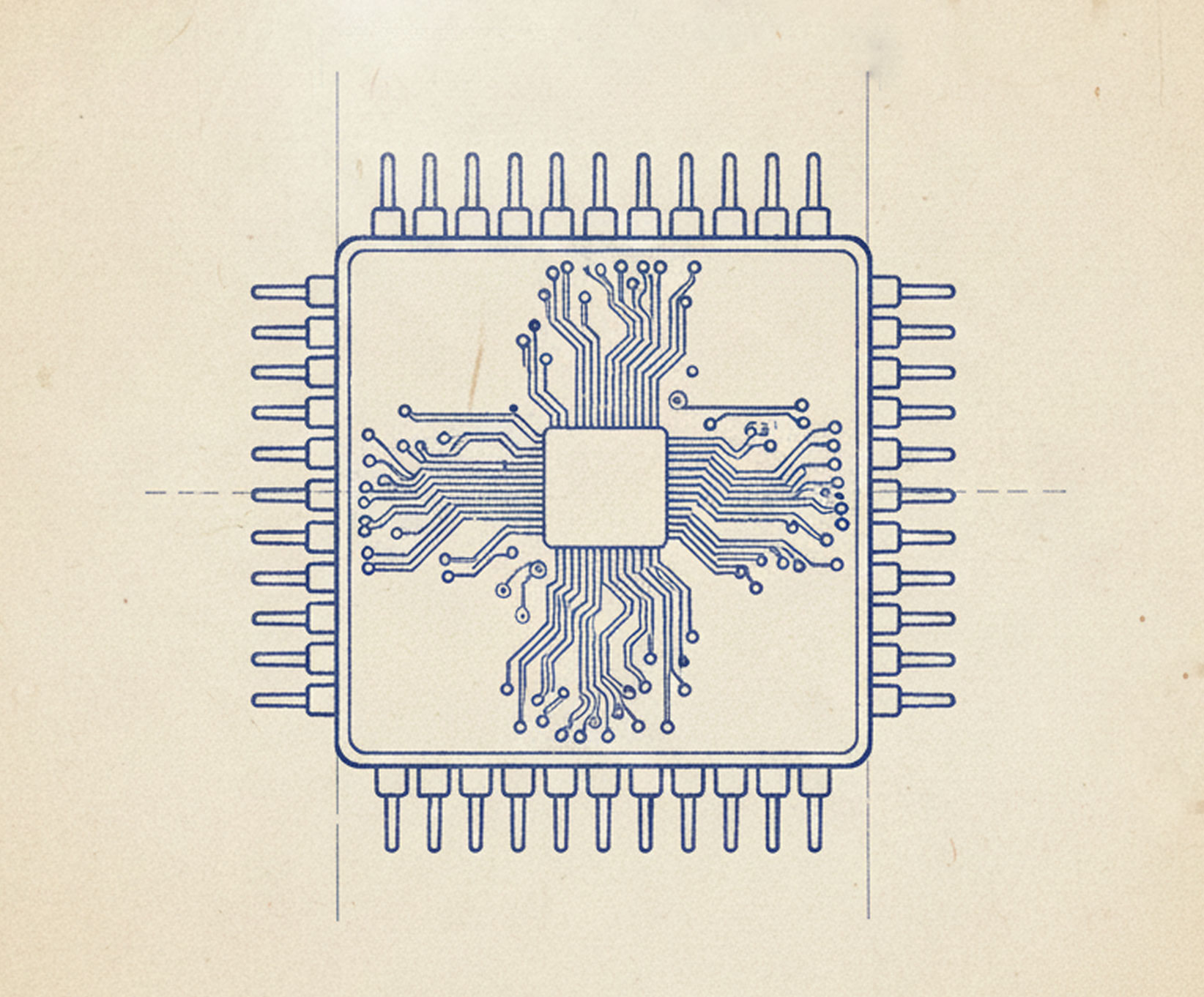
The Documentation Crisis of the 80s
In the early 1980s, the U.S. DoD was facing a major issue — how can we provide and give context to digital electronics design in a uniform way? A sea of vendors, integrated circuits, and complex digital design flooded the previously unbounded area of work. Manufacturers and designers all had different ways of documenting integrated circuits. Most typically, they’d use a combination of schematics and data sheets which provided some context, but ultimately a difficult-to-read circuit description. When programs would change hands or require clear documentation to satisfy regulatory standards, a major problem arose.
The solution was a government-funded IEEE project to create digital circuit documentation standards, resulting in a description language called VHDL. VHDL (VHSIC Hardware Design Language), an acronym inside another acronym — just what the people need!
VHDL’s Original Role: The Unambiguous Blueprint
The language was created as a way to describe digital circuits, not create them. It would be used as a documentation tool for ASIC (application-specific integrated circuits) hardware, basically any ‘chip’ that isn’t a CPU, RAM, etc, it’s application-specific! Hopefully, the picture is starting to paint itself — engineers needed to create application-specific digital circuits, and the government wanted a way to standardize the documentation of said circuits, outside of a purely schematic realm.
As a description language, VHDL isn’t very programmer-friendly — rather geared towards electrical engineers specializing in digital circuits.
The efforts of standardization turned into a way to visualize, describe, and modulate on digital circuits.
Demand for ASIC technology was growing, and from that the use of VHDL as documentation followed suit. Engineers were finding it easier to describe new zany ideas, and present them to cohorts in a way that made sense.
The Great Flip: From Description to Deployment
Someone thought it would be really cool (it was) if they were able to take the documentation/descriptions in VHDL and synthesize them onto actual hardware. I won’t bore the details in this post, but they did it. The engineering teams at Xilinx and Altera created the first FPGAs, field-programmable gate arrays.
As microchip technology continued to iterate and ASIC needs were at an all-time high, VHDL and FPGAs began to see the light of day. The hardware-accelerated advantages of ASIC design clicked with the field-programmable nature of the FPGA. Costs began to lower, and improvements in tooling brought FPGAs into the hands of extremely sophisticated, large-scale projects and your DIYers alike.
Today we see a world where FPGAs exist in ruggedized military and space use, consumer-level electronics such as the latest Apple silicon, M-series chips (though this is really an integrated FPGA, System-on-Chip or SoC), and even use in retro gaming system emulation. The hardware acceleration shift is pushing boundaries under our fingertips, and the new black box is becoming more accessible every day.
VHDL’s legacy is the ultimate pivot: a language conceived by the military to enforce standardized documentation became the essential engine of the FPGA revolution. It transformed digital design from a slow, fixed process into a fluid, synthesizable craft, enabling everything from consumer-grade System-on-Chips to perfect, cycle-accurate gaming emulation.
Loved the article? Hated it? Didn’t even read it?
We’d love to hear from you.