
“Coming together is a beginning;
keeping together is progress;
working together is success.”
—Henry Ford
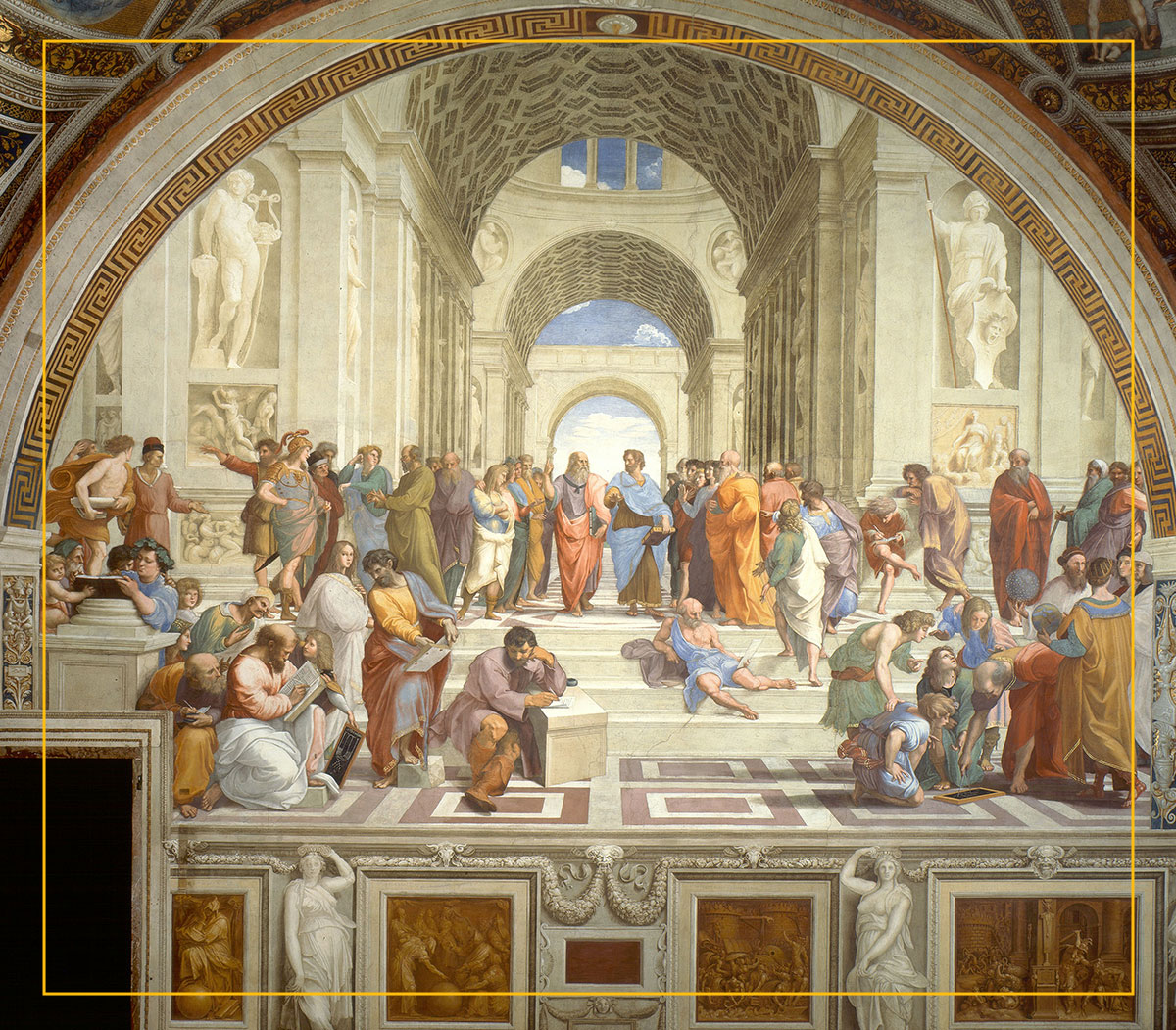
Image source: The School of Athens by Raphael (1511)
Intro
Last year, I wrote a blog post called, Speaking in CIM: The 26 Year Old Language of the Power Grid.
That post was mostly an overview, with a bit of history mixed in. If you’ve found yourself here and have never heard of the CIM, you should probably go back and read that first.
Anyway, I had a lot of fun last year researching and writing that post. And after it was published, I was pleasantly surprised by the feedback I received. I have had many great conversations with bright individuals thanks to that post.
One thing led to another, and in the Fall of 2025 I actually had the privilege and the honor of attending an in-person conference hosted by the CIM Users Group.
The CIM Users Group (a sub-group under the UCA International Users Group organization) hosts in-person events throughout the year, and I was lucky enough to find this Fall meeting happening at Siemens’ office in Wendell, NC, just 3 hours away from my hometown in Richmond, VA.
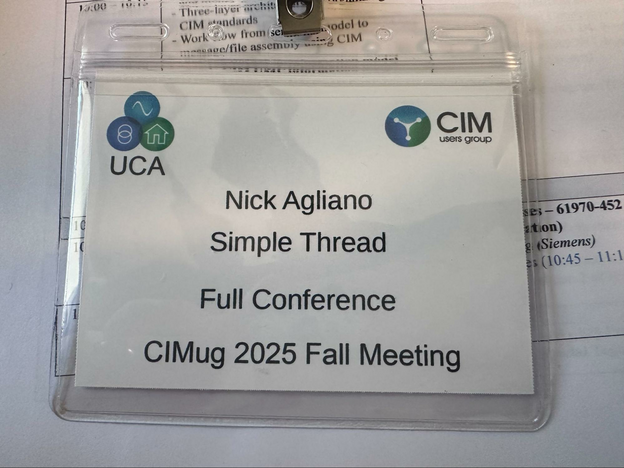
The conference was full of wonderful, like-minded individuals who were passionate about open-source standards for the electric utility industry.
After the CIM User Group meeting had come to pass, I decided that one of the best things I could do for the Common Information Model was to continue to write about it.
So I’m going to continue this series of CIM blog posts by diving into different sub-topics.
This post will focus on the people and organizations who write, build, and maintain the CIM.
UCAIug and the CIM Users Group
The first organization that you must know when it comes to any and all things CIM (Common Information Model) is one that I’ve already mentioned in the intro: the CIM Users Group.
The CIM Users Group, often abbreviated as CIMug, can be thought of as the core maintainer and stewards of the CIM standards.
I’ll also call out that “CIM standards” is sort of a squishy phrase. Sometimes when someone says “CIM” they’re referring to one, particular standard, and other times, they’re referring to a group of many standards. And then other times they’re referring to a very particular UML data model, which is actually an artifact that is used to generate downstream standards (more on that later).
You’ll probably find me switching back and forth, but I’ll try to be as clear as possible. When I say “CIM”, I’m probably referring this set of standards that (as of March 25, 2026) CIMug has listed on their about page:
IEC 61970 – For power system modeling and energy utility data exchange including EMS, topology, wires, SCADA, etc.
IEC 61968 – For power system modeling related to DMS, assets, work, GIS, metering and application messaging.
IEC 62325 – Modeling for energy markets with support for both North American and European markets (others under consideration).
Companion Standards – The CIM standards include a variety of extensions supporting many use cases including system planning, dynamic simulation, and smart grid messaging to premises systems
Ok, now back to CIMug.
CIMug is a sub-group of the UCA International Users Group (often abbreviated as UCAIug). UCAIug, a not-for-profit-corporation, has two other user groups that are not at all related to the CIM standards—the 61850 Users Group and the OpenFMB Users Group.
CIMug itself is made up of employees of UCAIug, as well as its members, which pay yearly dues.
What does CIMug do?
Earlier, I said that CIMug can be thought of as the core maintainer and steward of the CIM standards.
One important way that they steward the CIM standard is through education.
One very practical way that we can see this stewardship in action is in the CIM User Group meetings.
In most (or maybe all?) of the CIM User Group meetings, a significant portion of the scheduled content is instructional. For example, in the 3-day conference I attended, the entire first day was set aside for what they call “CIM University”. This is a full, 9 a.m. to 5 p.m. day of CIM knowledge, straight to the brain. People come to these meetings to learn about CIM from all over the world. Engineers, executives, leadership, management, product owners, from ISOs, RTOs, co-ops, small businesses, and big firms.
Alongside education, another very important responsibility of CIMug is developing, maintaining, and all of the other work that goes into “the UML”.
Now, I’m afraid I’m going to have to make another technical aside and explain what “the UML” means and how that relates to “CIM standards”.
But to explain what “the UML” means, we’re going to have to look at our next organization.
What is the IEC?
This section is going to be a bit dense, but please bear with me. I promise it’s important.
The International Electrotechnical Commission (IEC) is one of the three, big international standards bodies.
The big three being:
- IEC – electrotechnical standards
- ITU – telecommunications and radio standards
- ISO – almost everything else (quality, materials, processes, management systems, etc.)
When I was initially learning about the CIM, the most confusing thing to me was this specific relationship between the IEC and CIMug.
On CIMug’s about page, they reference IEC TC 57 in this blurb—
The CIM Users Group is focused on helping its members obtain the benefits of adapting IEC TC 57 modeling standards for all utility operations on a global basis…
TC, here, stands for Technical Committee. So, similar to how CIMug is a subgroup of UCAIug, IEC TC 57 is a group within the massive organization that is the IEC. This technical committee is specifically responsible for the published standards that we often think of as “the Common Information Model”.
If you go to the IEC TC 57’s website, they have this as a marketing blurb:
We develop and maintain International Standards for power systems control equipment and systems including EMS (Energy Management Systems), SCADA (Supervisory Control And Data Acquisition), distribution automation, teleprotection, and associated information exchange for real-time and non-real-time information, used in the planning, operation and maintenance of power systems.
Now let’s unpack the somewhat codependent relationship of CIMug to IEC TC 57.
First, it’s important to highlight that the standards published by the IEC TC 57 are not free, nor open-source. These standards are copyrighted and sold by the IEC.
The notable standards published by IEC TC 57 are:
- IEC 61970 – For power system modeling and energy utility data exchange including EMS, topology, wires, SCADA, etc.
- IEC 61968 – For power system modeling related to DMS, assets, work, GIS, metering and application messaging.
- IEC 62325 – Modeling for energy markets with support for both North American and European markets (others under consideration).
These three standards, as with all IEC standards, are defined, very formally, in a Microsoft Word document (and often viewed as a PDF).
The IEC depends on the CIM User Group to maintain the CIM, and submit revisions, when necessary, in order to adapt to the ever-evolving challenges that face the power grid.
This means that the CIM User Group is responsible for revising the standards, and then formally submitting revisions to the IEC for review. These submissions must follow the formally specified format (as Microsoft Word document) expected by the IEC, and a lengthy review process follows.
And what does CIMug get for all of their hard work? Well, they are rewarded with the CIM being formally accepted as an IEC standard. It’s a big deal, and a hard thing to do, to get a standard accepted by the IEC. In some ways, it made the CIM less of a dream for some electrically grid interoperability enthusiasts, and it became more of a reality. The CIM becoming a real IEC standard was a real, tangible step towards grid interoperability.
ENTSO-E and CIM in the European Union
In the history of the CIM, one of the most important, landmark events was the CIM becoming codified as IEC standards.
Downstream of these IEC standards, the next most important event(s) in the success and adoption of the CIM was the mandatory adoption in the European Union.
Here’s a brief timeline:
- 2009, ENTSO-E was established with the express goal of improving cross-border system operation, develop interoperability, and preparing technical groundwork for future EU rules
- 2010-2011, ENTSO-E started publishing CIM profiles, purely on a voluntary / preparatory basis
- 2013, CGMES (Common Information Model for Grid Models Exchange), published by ENTSO-E
- ~2015, new grid network codes began to be approved by European energy regulators which mandated grid data exchange in the format specified by ENTSO-E, which was CGMES—a CIM based format!
So, 10 years after CIM was created, transmission operators were required by the EU to provide grid models in a CIM-based format.
And now we’re 10 years into those mandates, and the CIM is alive and well in Europe.
This widespread adoption in Europe meant that the CIM would be put through many trials and tribulations, as many different utilities were quickly adopting the new standard into their systems. Many software vendors popped up and provided CIM-based tools, or provided consulting services to grid operators who suddenly had to provide CIM models to their regulatory authorities.
The result was a much healthier, much more well-known standard.
What is “the UML”
Now that we’ve made it clear what IEC standards are, and that they are not free, and are not open source, we can go back to exploring what parts of the CIM are free and are open-source.
This is where we get to explore what CIM users mean when they refer to, “the UML”.
“The UML” refers to the ontological data model that CIMug maintains. Funny enough, it’s not true UML (Unified Modeling Language) format, but rather a very special variant of UML. But that’s a topic for another post.
It’s an “ontological model” model, meaning that it doesn’t contain any proper data itself, but rather it’s a formal specification of how to represent objects, concepts, and other entities, and their relationships to one another. In the case of the CIM, the “objects, concepts, and other entities” that we’re modeling are all related to the power grid and its data.
For example, a very, very small subset of the ontological model (as UML) looks a bit like this—
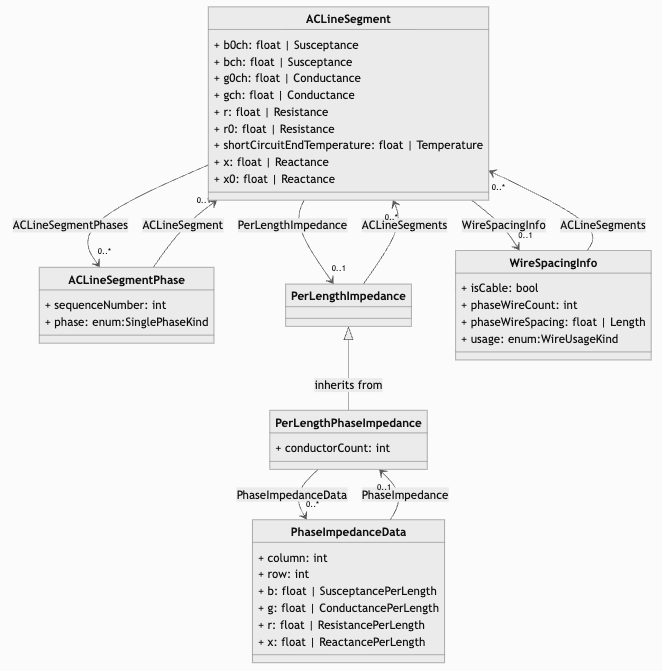
(Credit to PNNL, A Power Application Developer’s Guide to the Common Information Model)
This ontological model is painstakingly maintained by CIM user group members (and specifically by members of the model maintenance team). These maintainers use very specialized tools, like Enterprise Architect, to maintain and extend this model.
This UML model is ultimately taken, processed, and then turned into the formal definition of the IEC standards.
It can be thought of as an upstream artifact that is used to generate the downstream IEC standards.
But, most importantly, this artifact (the UML model) is free and open-source.
So while the official CIM standards published by the IEC are closed-source and proprietary, the ontological model, itself, is free and open source.
Unfortunately, I can’t give you a link and say, “here you go, go explore the CIM ontological model”, because, currently, the best way to view it is to use Enterprise Architect, which costs at least $245 for a license. But if you do have EA, you can go to the CIMug Artifacts site, download a .eap file, and start exploring!
Conclusion
Understanding the big players and the dynamics between these organizations was hugely important to me as I tried to enter the CIM world. Between the intro post to CIM, and this post exploring the orgs, hopefully the Common Information Model is slowly being demystified.
In the next post, we’ll be exploring these questions:
- “Is CIM For Planning or Operations?”
- “Is CIM For Transmission or Distribution”
Loved the article? Hated it? Didn’t even read it?
We’d love to hear from you.