
As transmission corridors become more congested, the space around energized infrastructure is becoming more valuable and more complicated.
Utilities are rebuilding and expanding lines. Developers are siting new generation, storage, and large loads closer to existing infrastructure. Transportation, pipeline, telecommunications, and industrial assets often share or cross the same rights-of-way. In that environment, one question becomes increasingly important:
What happens to nearby conductive objects when they sit inside the electric and magnetic fields created by energized power lines?
That is the core question behind electromagnetic and electrostatic induction studies.
These studies are not just academic exercises. They help identify whether nearby fences, pipelines, vehicles, structures, rail systems, communication lines, or substation equipment could experience induced voltages or currents during normal operating conditions. In some cases, those induced effects can create safety concerns for field personnel, the public, livestock, or nearby infrastructure.
As the grid changes, understanding these effects is becoming an essential part of responsible power system planning and design.
Induction Is a Normal Operating Condition, Not Just a Fault Concern
When people think about electrical safety studies, they often think first about faults: touch potential, step potential, short-circuit events, and grounding performance under abnormal conditions.
Those studies are critical. But induction studies look at a different type of risk.
Electromagnetic and electrostatic induction can occur under steady-state, normal operating conditions. Energized conductors produce electric and magnetic fields that extend into the surrounding space. When nearby conductive objects are exposed to those fields, voltages and currents can be induced depending on the object’s geometry, grounding condition, material, and proximity to the source.
That distinction matters.
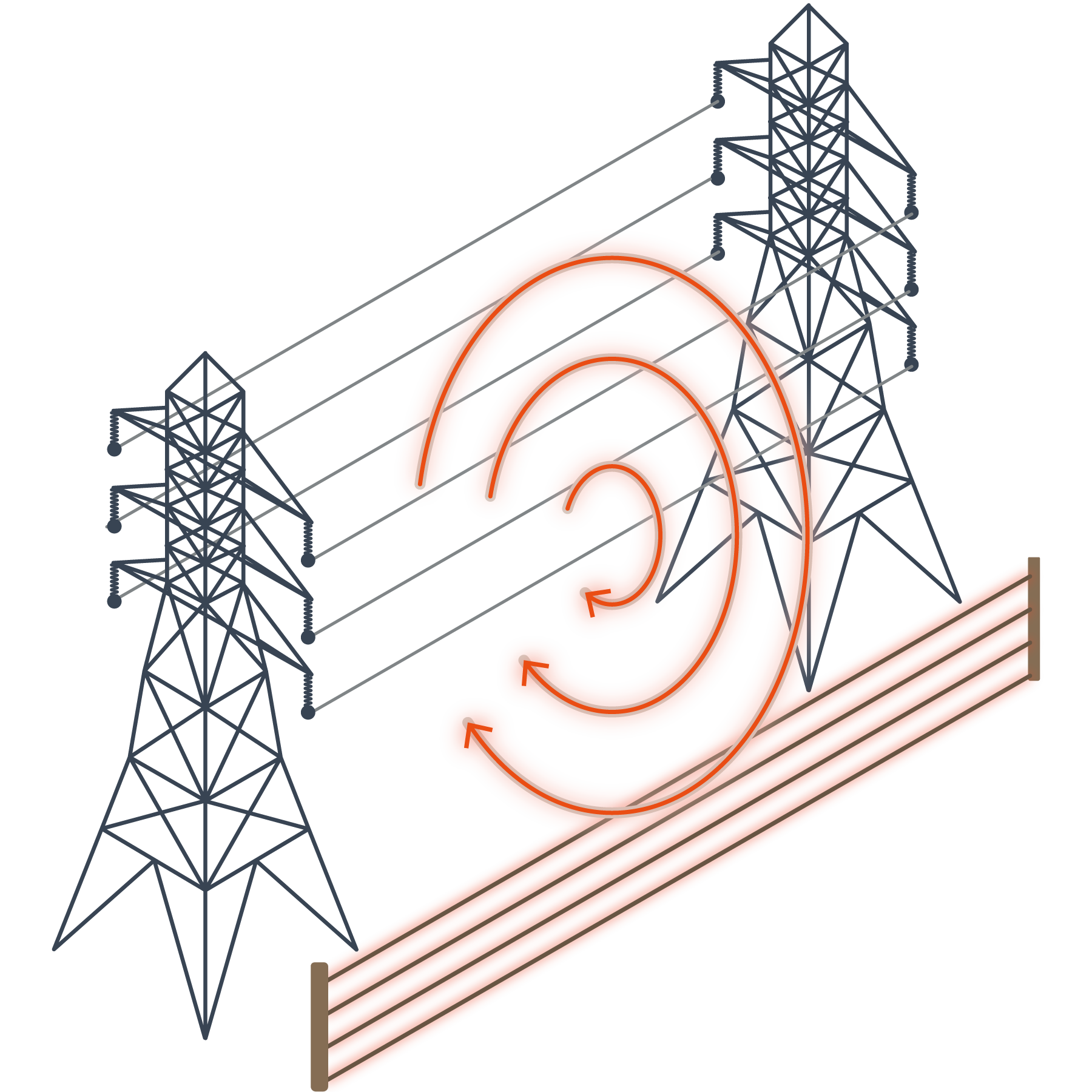
Induced Voltage and Current Report; A Review of Public Hazards Associated with High-Voltage Transmission Lines. Oregon Department of Energy — Feb. 2013
A fence, pipeline, vehicle, or structural component does not need to be part of a fault event to become energized. It may experience induced voltage simply because it is located near an operating transmission line or other energized conductor.
The magnitude may be lower than a fault-related hazard, but the exposure can be persistent. That is what makes induction studies important for safety, design, and mitigation planning.
Two Different Mechanisms: Magnetic and Electric Field Coupling
Induction studies generally consider two related but distinct mechanisms.
The first is electromagnetic induction, which is driven by magnetic fields. When current flows through an overhead conductor, it creates a magnetic field around the conductor. If that magnetic field intersects a nearby metallic object, it can induce a voltage along the object. If the object is grounded, current can flow through it.
A practical example is a grounded fence running near a transmission line. Depending on the line current, fence length, grounding arrangement, and separation distance, the fence may carry induced current that could create a shock hazard when touched.
The second is electrostatic induction, which is driven by electric fields. Electric fields are created by voltage differences between energized conductors and nearby objects. Conductive objects that are isolated from ground, such as certain vehicles, equipment, or metallic structures, can experience induced voltage through capacitive coupling.
If a person touches that isolated object, a discharge current may flow through the body. This can be perceptible, uncomfortable, or hazardous depending on the conditions.
Both mechanisms are important, and both need to be modeled carefully.
Why These Studies Are Becoming More Important
The need for induction analysis is growing because the grid is becoming more physically and electrically complex.
More transmission upgrades are being planned to support load growth, renewable integration, data center development, electrification, and broader reliability needs. At the same time, existing corridors are often being reused or expanded rather than replaced with entirely new rights-of-way.
That creates more opportunities for close proximity between energized conductors and other conductive infrastructure.
For utilities and energy organizations, this raises practical questions:
- Are nearby metallic objects exposed to unacceptable induced voltages or currents?
- Are electric and magnetic field levels within applicable exposure limits?
- Could induced voltages accelerate corrosion on nearby infrastructure?
- Could communication systems experience interference?
- Are grounding, bonding, shielding, or procedural controls needed?
- Do field crews need specific work practices or personal protective equipment?
These are not questions that can be answered confidently with rough assumptions alone. The geometry, grounding, soil characteristics, conductor loading, and physical layout all matter.
That is why detailed modeling is so important.
What Good Modeling Has to Capture
A defensible induction study requires more than a simplified representation of a line and a nearby object.
The model needs to reflect the physical system with enough detail to produce meaningful results. That includes conductor type, diameter, resistance, spacing, circuit configuration, clearances, sag, shield wire grounding, phase energization, maximum loading conditions, soil resistivity, and nearby conductive objects.
It also requires careful attention to the geometry of the system. Conductive objects may be above ground, buried, isolated, grounded at one end, grounded at multiple points, or connected in complex ways. Small modeling assumptions can change the results.
For electromagnetic and electrostatic induction studies, tools such as SES/HIFREQ within CDEGS are commonly used because they allow engineers to build detailed three-dimensional models and solve the field interactions directly. That level of modeling helps account for effects such as multi-layer ground, soil return paths, leakage, and complex coupling between energized conductors and nearby objects.
This matters because induction problems are inherently spatial. The distance between objects, their orientation, their length, and their grounding configuration all affect the final result.
Standards and Limits Provide the Safety Framework
Engineering judgment is important, but induction studies also need to be tied to recognized standards and guidance.
IEEE C95.6 provides exposure limits for electric and magnetic fields in the 0–3 kHz range, including limits at power frequency. These limits help define acceptable exposure for the public and for controlled environments where trained personnel, work practices, and PPE may apply.
Additional industry guidance, including EPRI references, is often used when evaluating discharge current from isolated objects such as vehicles. For example, guidance commonly considers whether discharge current through a person touching a large isolated object remains within acceptable limits.
The goal is not just to calculate field values. The goal is to determine whether the system is safe, whether exposure is acceptable, and whether mitigation is needed.
Mitigation Is Part of the Study, Not an Afterthought
A useful induction study should not stop at identifying a problem.
If induced voltages, currents, or field levels exceed acceptable thresholds, the next step is to evaluate practical mitigation options. These may include grounding, bonding, shielding, changes to physical layout, revised work practices, or procedural controls for field crews.
The right mitigation depends on the object, the source of coupling, the operating conditions, and the site constraints. In some cases, a grounding change may be enough. In others, the solution may require a more detailed evaluation of object geometry, clearances, or construction practices.
This is where modeling becomes especially valuable. Engineers can compare scenarios, test sensitivities, and evaluate whether a proposed mitigation approach actually reduces risk before changes are made in the field.
The Bigger Picture: Better Models Lead to Better Decisions
Power system studies are becoming more demanding across the industry.
Planning teams are being asked to evaluate more scenarios, incorporate more uncertainty, and make decisions faster. At the same time, the physical grid is becoming more interconnected with transportation, communications, industrial, and energy infrastructure.
Induction studies are a good example of why detailed modeling still matters.
They require a strong understanding of power systems, electromagnetic field behavior, engineering standards, and practical field conditions. They also benefit from better workflows, better data handling, and repeatable study methods.
As the grid continues to evolve, these studies will play an important role in helping utilities and developers understand risk, protect people, and make defensible engineering decisions.
Need Support With Power System Modeling?
Simple Thread is expanding our power systems modeling services to help utilities, developers, and energy organizations study complex grid behavior with more clarity and confidence.
Our team supports detailed modeling and analysis across transmission and distribution systems, including electromagnetic and electrostatic induction studies, transients analysis, interconnection support, hosting capacity, and other advanced power system studies.
If your team is trying to evaluate a complex study, improve an existing workflow, or turn manual study processes into something more repeatable and scalable, we’d be happy to talk.
Loved the article? Hated it? Didn’t even read it?
We’d love to hear from you.