
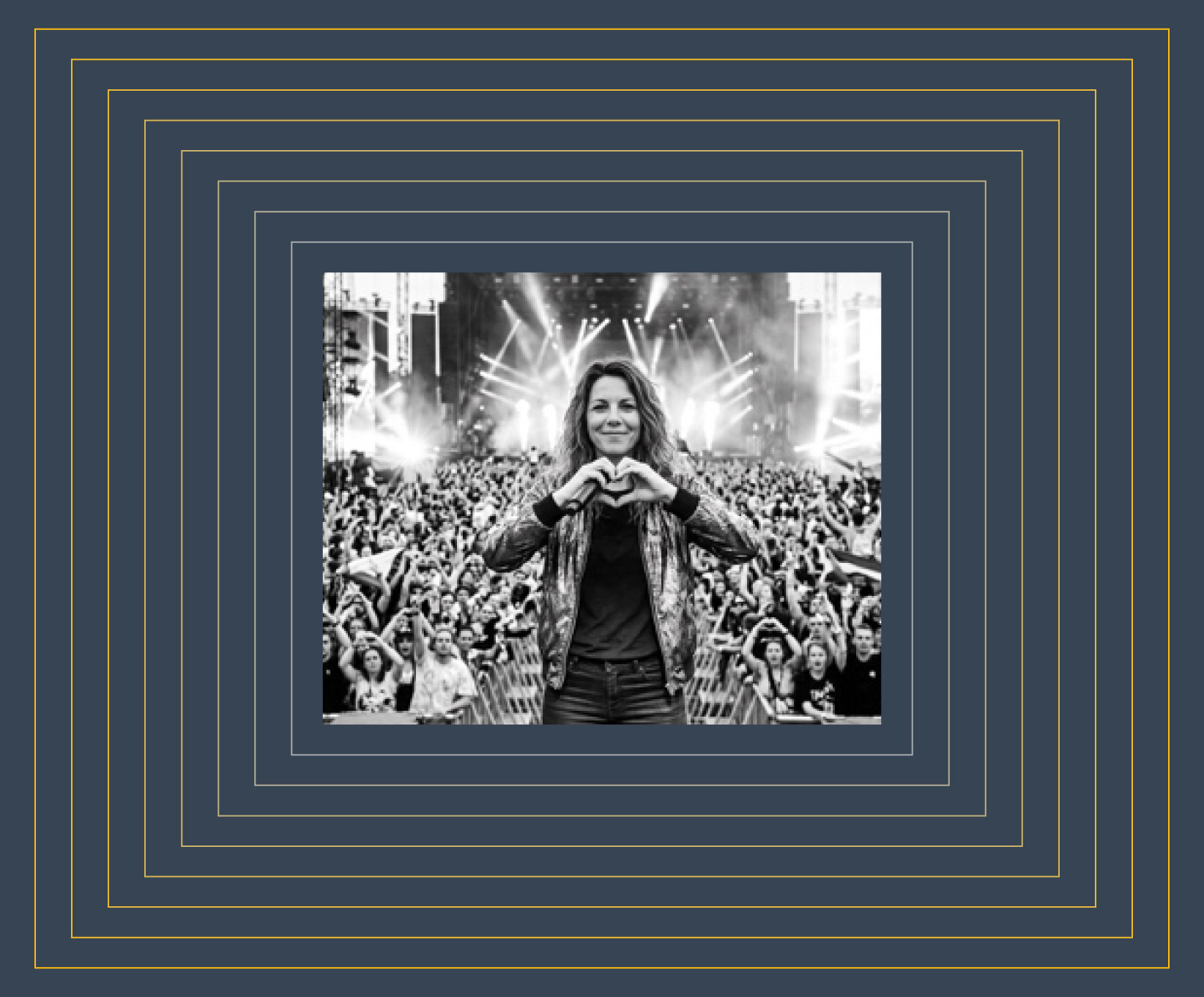
Can a short snippet of sound contain the entire DNA of an artist?
Recently, I read a post by our very own Austin Carr discussing the evolving frontier of content creation—specifically, how creators can utilize artificial intelligence to construct full virtual pseudonyms and digital identities. The concept fascinated me. How much creative heavy lifting could generative AI really do? Could an AI model take something as abstract as a brief musical idea and flesh out a convincing, multi-dimensional AI virtual artist persona from scratch?
I decided to run an experiment: start with nothing more than an unreleased, 46-second track, feed it into Google’s Gemini, and see how far down the rabbit hole of virtual identity design we could go.
Here is what happened—from the DAW (digital audio workstation) to the festival mainstage.
Part 1: The Virtual Pseudonym
The core premise behind Austin’s post was intriguing: in a world saturated with personal branding, virtual pseudonyms allow creators to explore new creative directions, genres, and aesthetics unburdened by the real world.
I wanted to test the friction and boundaries of that workflow. Starting with a blank slate, I wanted to see if AI could reverse-engineer an artist’s visual look, personality, lore, and branding solely from the emotional texture and sonic palette of a short clip of music.
Part 2: The Song
Before I could introduce any persona, I needed the music itself.
Flipping open FL Studio, I dove into the Fruity Loops SoundCloud library looking for raw materials. Setting the key to G and dialing the tempo to 130 BPM, I filtered through loops and quickly found a complementary palette:
- An ethereal female vocal hook repeating “I feel it in the air… in my heart… in my soul”
- Bright, melodic synth plucks
- Driving four-on-the-floor percussion
- Uplifting string swells and rhythmic guitar strums
After assembling the parts into an arrangement that climbed into an energetic electronic pop/dance-pop drop, I added post-processing, dialed in sidechain compression, and polished the mix. Wanting to lean into AI right from the audio stage, I ran the unmastered track through FL Studio’s built-in AI mastering engine to dial in the final balance and loudness.
With melody, movement, and mood set—it was ready for its artist.
Listen here: “Aura” on Bandcamp
Part 3: The Character Generation (and a Happy Accident)
With the track finished, I uploaded the clip into Gemini and prompted it with very little upfront direction: create a profile picture for a woman who would match the vocal tone and resemble an EDM musician.
The first generation gave me a sharp, neon-lit portrait—though she looked distinctly like a DJ behind a set of decks and wearing oversized headphones instead of the singer I envisioned. I asked for a minor tweak: make her look more like a live singer performing the song, not a DJ. Gemini delivered a close-up shot of her gripping a handheld mic against a backdrop of arena-style stage lights.

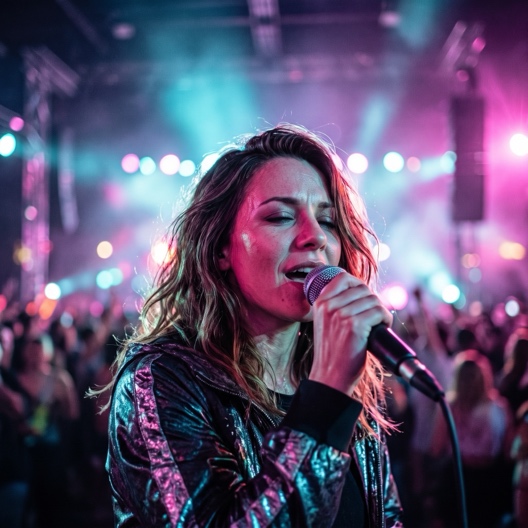
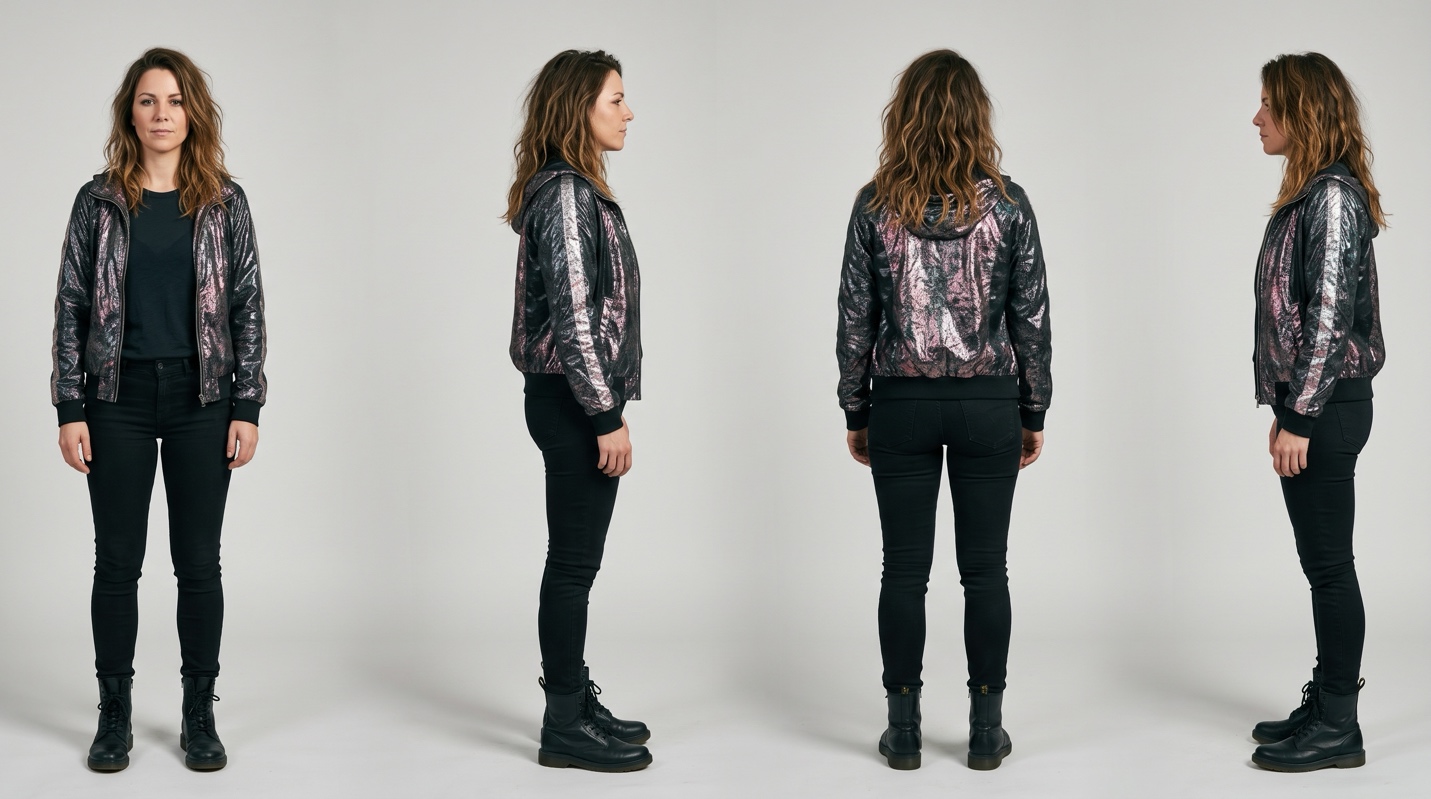
Now that the face existed, I knew from prior research that continuity is one of the hardest challenges in AI imagery. If you want a consistent subject across future renders, generating a “character sheet”—a turnaround showing the subject from the front, left side, back, and right side against a neutral backdrop—gives the model a 360-degree reference point to anchor features, proportions, and outfit details.
I typed in a request for a character sheet. But by pure accident, Gemini interpreted my prompt in a completely different way.
Instead of generating an image turnaround, it returned a comprehensive, written creative character description (the full character description can be found in the appendix):
- Name: Lyra Vance (LYRA)
- Vocal Style: Light lyric soprano/mezzo-soprano, airy verses opening into resonant festival anthems
- Wardrobe Aesthetic: Iridescent holographic bomber jackets, dark denim, custom chrome in-ears
- Personality & Lore: A grounded, indie-folk acoustic songwriter turned electronic synth enthusiast who thrives on crowd connection and late-night studio sessions
While it wasn’t the turnaround sheet I had initially intended to generate (I followed up and generated the visual turnaround right after), this accidental detour turned out to be the turning point of the experiment. Having a named, fleshed-out human being with motivations, vocal descriptions, and a distinctive fashion identity gave the project a soul. Suddenly, she wasn’t just an anonymous render—she was Lyra.
Part 4: Content Creation
Now that Lyra had an identity, I wanted to see if I could begin to populate a social media feed for her. The goal was to generate high-energy, documentary-style concert photos from major festival environments like Ultra Music Festival or Tomorrowland.
I leaned into more detailed prompts: cinematic, journalistic, black-and-white photography, performing in front of massive festival crowds.
The generated imagery was decent:
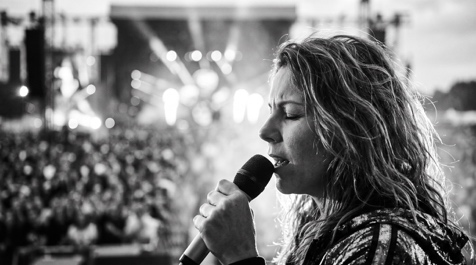
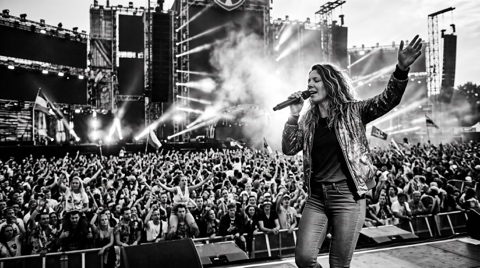
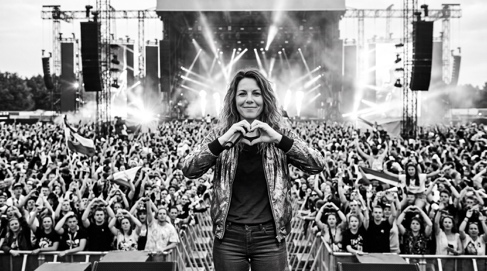
Interestingly, Gemini seemed to make an unprompted creative decision of its own: in several wide shots, rather than standing on a towering, isolated main stage, she was positioned close to the crowd barricades or on a secondary platform out in the audience space. While not quite the typical mainstage setup, the compositions felt reasonably authentic and attention-grabbing.
It proved to me that with only slight prompt refinements, you could generate a consistent, week-to-week Instagram presence for a virtual artist in an afternoon.
Part 5: Branding – The Logo vs. The Album Art
Branding is where the visual rubber meets the road, and this stage provided the clearest illustration of where AI shines versus where it struggles.
The Logo: Spontaneous Synergy
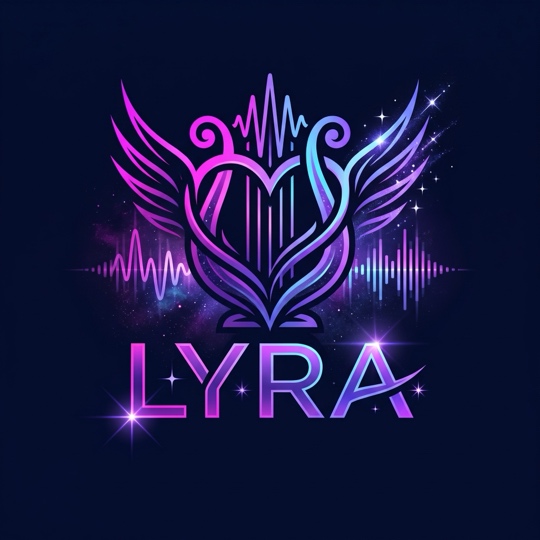 With fairly minimal prompting, I asked Gemini to generate an artist logo embodying her singing style and identity. It came back with an emblem combining a classical lyre (playing on her name, Lyra), angel-like wings, neon soundwaves, and a central heart crest—rendered in violet and electric cyan.
What struck me was the heart motif nested inside the lyre strings. Was it purely coincidental, or harkening back to the performance shot generated earlier, where she formed a heart with her hands? Either way, it felt like an authentic trademark gesture—something fans at her concerts would mimic back to her from the crowd, and its inclusion in the logo was a neat addition.
The Album Art: The Limitations of Specificity
While the logo was a quick success, creating the album cover for her track, “Aura,” was a slightly different story.
I had a very particular visual layout in mind: a cosmic sunset, maintaining the purple/magenta palette, featuring a subtle, wordless version of the logo tucked in the lower left corner, with the title “Aura” centered and clean.
 Here, the experiment bumped into the current limits of generative image models:
- Asking to move text, scale down certain words, or eliminate specific elements often resulted in the model either ignoring the spatial instruction, regenerating text where it didn’t belong, or shifting the entire composition unexpectedly.
- It took repeated rounds of prompts to get anywhere close. While the final artwork looked visually polished on its own, it was still a compromise compared to the precise layout I set out to make.
However, I noticed an important pattern during the struggle: the smaller and more incremental the requested change, the better the model handled it. When I tried to change three variables at once (e.g., text size, text placement, and background elements), the output drifted drastically. When I narrowed each prompt down to a single, isolated edit, the results were far more predictable.
Part 6: Key Takeaways & Conclusion
Looking back at the whole workflow, it’s amazing how much ground can be covered in a single session:
- Started with a 46-second draft loop assembled from samples.
- Ended up with a fully visualized singer, a detailed artist bio, live performance photography, a signature stage motif, a vector-style logo, and release cover art.
Beyond the novelty of building a digital pop persona, this experiment taught me two major lessons about collaborating with AI:
- Creative Accidents Can Ground the Vision: The misinterpretation that led to the text-based character sheet turned out to be a valuable moment of the experiment. Once the AI gave her a name, a vocal profile, and a philosophy, it completely reshaped how I prompted her visuals and marketing materials. Giving your concept depth early makes every subsequent output stronger.
- Atomic Prompting Over Big Leaps: AI models are good at lateral creativity and broad-stroke conceptualization, but they struggle with surgical precision. If you have a specific target in mind, don’t try to jump from A to Z in a single paragraph. Break edits into the smallest possible discrete steps. Treating prompt engineering as an incremental sculpting process rather than a one-shot command produces vastly superior results.
Whether virtual artists will soon populate festival lineups or remain a niche storytelling medium, one thing is certain: the barrier between hearing a melody in your head and rolling out a complete visual campaign around it has never been lower.
Appendix
Full character profile generated
1. General Overview
- Stage Name: Lyra Vance (or LYRA)
- Real Name: Evelyn “Evie” Vance
- Role: Lead Vocalist, Topliner & Electronic Pop / EDM Co-Producer
- Genres: Progressive House, Melodic Bass, Electropop, Trance
- Tagline: “Anthems for the heart, rhythms for the soul.”
2. Visual & Aesthetic Profile
- Age Appearance: Late 20s (approx. 27–29)
- Hair: Wavy, mid-length honey-brown with subtle textured layers and sun-kissed blonde highlights, often styled in an effortless, windblown stage look.
- Eyes: Warm hazel / amber, expressive and emotive under stage lighting.
- Signature Style:
- Stage Wardrobe: Iridescent or holographic cropped bomber jackets, dark metallic fabrics, comfortable performance wear accented with neon/glow elements.
- Accessories: In-ear monitors with custom metallic casing, minimalist silver rings, and a sleek handheld wireless mic.
- Color Palette: Magenta, cyan, deep indigo, and metallic chrome.
3. Vocal & Performance Profile
- Vocal Range / Type: Light Lyric Soprano / Mezzo-Soprano
- Vocal Characteristics:
- Tone: Bright, crystalline, and airy in the verses, opening into a powerful, resonant belt for emotional festival-anthem builds and hooks.
- Style: Emotive toplines that seamlessly bridge intimate storytelling with euphoric, festival-scale choruses.
- Stage Presence:
- Highly energetic and deeply connected with the crowd.
- Closes her eyes during emotionally climactic phrases, letting the music take over before engaging directly with the front rows.
- Natural movement—bouncing with the drop and feeding off the energy of the bass and lights.
4. Personality & Vibe
- Off-Stage Persona: Warm, grounded, approachable, and a self-professed synth/audio nerd who loves collaborating late into the night in cozy studio sessions.
- On-Stage Persona: Magnetic, euphoric, and passionate—transforms every venue into an intimate space regardless of the crowd size.
- Key Inspirations: Ellie Goulding, Lights, Becky Hill, HALIENE, and Krewella.
5. Lore & Backstory
- Origins: Grew up writing indie-folk ballads on an acoustic guitar before discovering the immersive world of electronic production at an underground festival.
- Breakthrough Moment: Teamed up with an up-and-coming producer to drop a self-released track that unexpectedly caught fire in festival sets across the summer circuit.
- Current Era: Headlining club tours and festival stages, known for turning deeply personal lyrics about connection, resilience, and human emotion into massive dance-floor anthems.
“Character Sheet” generated




'%3e%3cg id='Final-Copy-2_2_' transform='translate(1275.000000, 200.000000)'%3e%3cpath class='st0' d='M7.4,12.8h6.8l3.1-11.6H7.4C4.2,1.2,1.6,3.8,1.6,7S4.2,12.8,7.4,12.8z'/%3e%3c/g%3e%3c/g%3e%3c/g%3e%3cg id='final---dec.11-2020'%3e%3cg id='_x30_208-our-toggle' transform='translate(-1275.000000, -200.000000)'%3e%3cg id='Final-Copy-2' transform='translate(1275.000000, 200.000000)'%3e%3cpath class='st1' d='M22.6,0H7.4c-3.9,0-7,3.1-7,7s3.1,7,7,7h15.2c3.9,0,7-3.1,7-7S26.4,0,22.6,0z M1.6,7c0-3.2,2.6-5.8,5.8-5.8 h9.9l-3.1,11.6H7.4C4.2,12.8,1.6,10.2,1.6,7z'/%3e%3cpath id='x' class='st2' d='M24.6,4c0.2,0.2,0.2,0.6,0,0.8l0,0L22.5,7l2.2,2.2c0.2,0.2,0.2,0.6,0,0.8c-0.2,0.2-0.6,0.2-0.8,0 l0,0l-2.2-2.2L19.5,10c-0.2,0.2-0.6,0.2-0.8,0c-0.2-0.2-0.2-0.6,0-0.8l0,0L20.8,7l-2.2-2.2c-0.2-0.2-0.2-0.6,0-0.8 c0.2-0.2,0.6-0.2,0.8,0l0,0l2.2,2.2L23.8,4C24,3.8,24.4,3.8,24.6,4z'/%3e%3cpath id='y' class='st3' d='M12.7,4.1c0.2,0.2,0.3,0.6,0.1,0.8l0,0L8.6,9.8C8.5,9.9,8.4,10,8.3,10c-0.2,0.1-0.5,0.1-0.7-0.1l0,0 L5.4,7.7c-0.2-0.2-0.2-0.6,0-0.8c0.2-0.2,0.6-0.2,0.8,0l0,0L8,8.6l3.8-4.5C12,3.9,12.4,3.9,12.7,4.1z'/%3e%3c/g%3e%3c/g%3e%3c/g%3e%3c/g%3e%3c/svg%3e) Your Privacy Choices