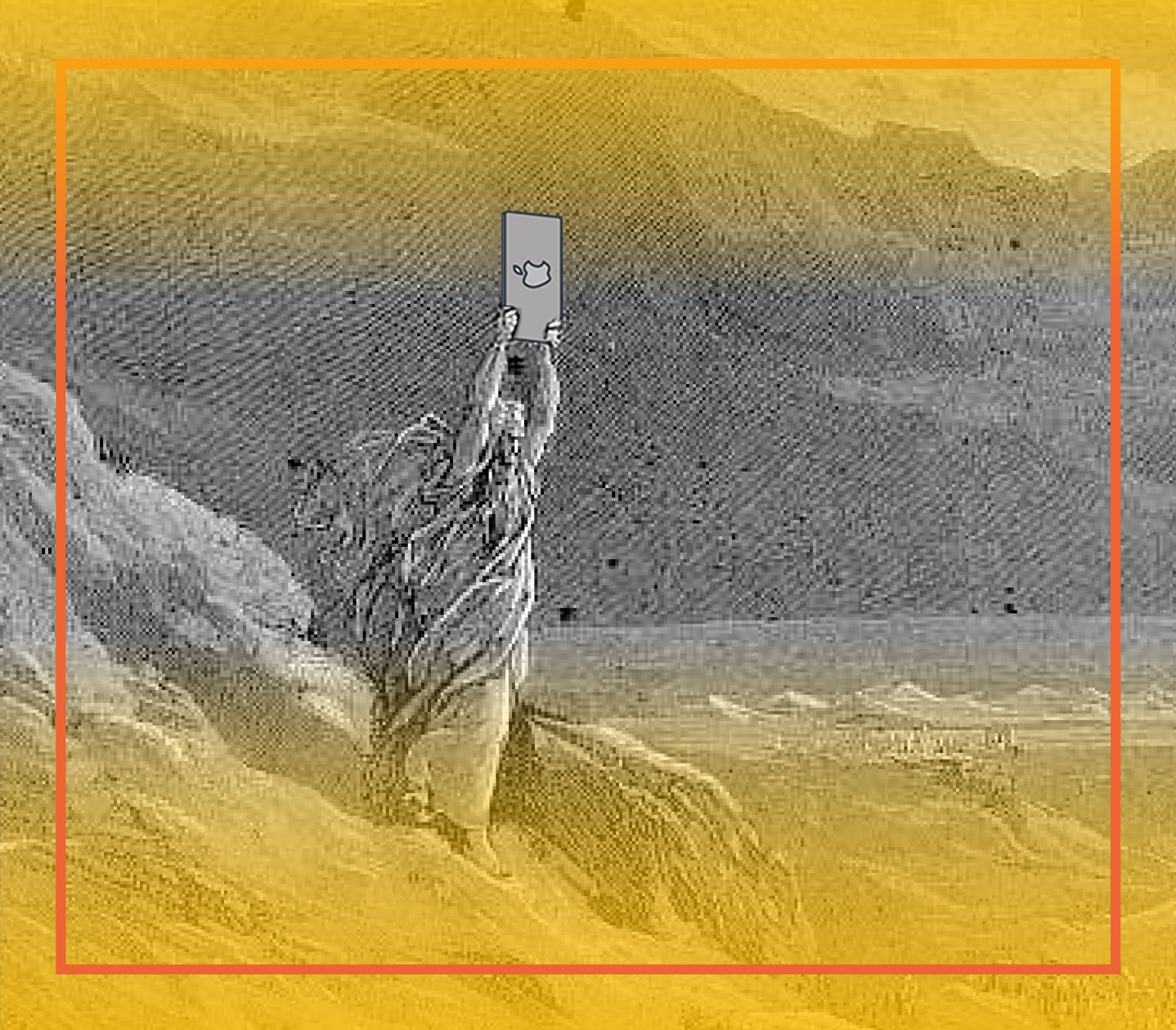
Following our thesis on programming ethics, the considerations of a Platonic Programmer and finally the re-orientation to the Neoplatonic Programmer, we now venture to contemplate the ethical, Platonic usage of AI by the Programmer.
Epistrophe and Eidolons
“The story goes that Thamus said many things to Theuth in praise or blame of the various arts, which it would take too long to repeat; but when they came to the letters, “This invention, O king,” said Theuth, “will make the Egyptians wiser and will improve their memories; for it is an elixir of memory and wisdom that I have discovered.”
Throughout this series, the ethical obligation of the Programmer has shifted from an active to a more passive act. The Programmer as Platonic craftsman must emerge from the Cave, see the Forms with the Light, contemplate them with Reason and then craft material shadows of the observed Forms. Later, The Programmer as Neoplatonist is a conduit through which the Forms emanate from the One into the Program and cosmogenic Execution.
The phenomenon of the Programmer comprehending the Forms, driven by a longing (ἔρως, “desire”) for the Good and turning back towards the One is referred to as Epistrophe (ἐπιστροφή, “return”).
For the Platonic Sophocrat this is the Cave-emerging, Sun-gazing, dialectizing. The Neoplatonic Theurgist, however, is contemplative, ritualistic, gazing upward.
Here we find a slight development of the thesis – the Theurgist must turn towards the One (Sun) to receive its emanations. So while the Platonist is acquiring Reason with reasoning, the Neoplatonist is, by recognizing the derivative nature of material, Human existence, seeking metaphysical union with the supra-intelligible realm or the One. This union is referred to as Henosis (ἕνωσις, “union” or “oneness”).
The Theurgist recognizes that the Human soul is an Eidolon (εἴδωλον, “phantom”, “image”, from εἶδος (“form”, “idea”) + diminutive -olon.) of the divine intellect. An etymologically powerful term, recalling the Platonic Form (εἶδος in Greek), an Eidolon is, at any level of the Neoplatonic hierarchy, the shadow of a higher level. This lesser-idea is not necessarily an evil or errant phenomenon but a recognition and reinforcement of the diminution inherent to the unfolding of the One into the lower levels of reality.
Amalgamic Intelligence
But Thamus replied, “Most ingenious Theuth, one man has the ability to beget arts, but the ability to judge of their usefulness or harmfulness to their users belongs to another; and now you, who are the father of letters, have been led by your affection to ascribe to them a power the opposite of that which they really possess.”
In the previous piece we placed the Programmer, Program and Execution into the Neoplatonic hierarchy in the Nous, Soul and Cosmos, respectively. Now that most Programmers use some form of an Artificial Intelligence tool to aid in their Program creation – how can we approach classifying AI in this paradigm?
Given the Reason contained in an AI system is built off of a multitude of human written knowledge, this lens offers a couple of interesting esoteric classifications.
An egregore (ἐγρήγορος, “wakeful”) is a metaphysical being, or according to René Guénon a “collective entity”, awakened into existence by the collective thoughts and emotions of some group of people. In the Greek translation of the Book of Enoch, angels or Watchers are translated as ἐγρήγοροι. Some of these angels are fallen and later esoteric tradition believes that an awakened thoughtform can be possessed by one of these fallen angels.
A desire for a more straightforward terminology would lead us to view AI as an Amalgamic Intelligence – an entity whose reasoning is limited to a large but static set of human content on which it is trained.
Here we have an interesting inversion of the famous Heraclitean line: “For this reason it is necessary to follow what is common. But although the λόγος is common, most people live as if they had their own private understanding.” On one hand, the Amalgamic “Intelligence” possesses in a sense a “common understanding” because it reasons with the vast array of written Human knowledge. But instead it has a more “private understanding” of the Logos – while vast, the content driving it is static, limited and, most importantly, devoid of the Human Soul.
Logos Endiathetos
“For this invention will produce forgetfulness in the minds of those who learn to use it, because they will not practice their memory. Their trust in writing, produced by external characters which are no part of themselves, will discourage the use of their own memory within them.”
The Stoics developed a binary later referenced by Christian theologians – Logos Endiathetos (λόγος ἐνδιάθετος, “internal word”) and Logos Prophorikos (λόγος προφορικός, “uttered word”). Philo of Alexandria, a Hellenistic Judaist, saw Moses and Aaron as the Endiathetos and Prophorikos. God did not speak to Moses but spoke within Moses who then used Aaron to communicate God’s Word to the people.
With a particularly earnest mind, one can view the amalgamic agent as driven by the egregoric Prophorikos – the uttered, written word – of humankind. But it contains only logos-as-word. The human Programmer must receive and provide the Endiathetos or Logos-as-Reason to the agent. Like Moses, the Programmer must Turn to divine Reason and receive within the mind the Logos and use the amalgamic agent to communicate to the Program.
Caution must be issued here to not over-extend grace to the AI and hallucinate it an Endiathetos. We established in 1270 that the Averroist doctrine of monopsychism, or that “there is numerically one and the same intellect for all humans”, is false and heretical. The simulated internal reason of an AI agent is, in the words of Theuth, the “appearance of wisdom, not true wisdom”. And such a phenomenon would certainly not arise out of an egregore with limbs formed from millions of Reddit comments.
Samael or Sophocrat
“You have invented an elixir not of memory, but of reminding; and you offer your pupils the appearance of wisdom, not true wisdom, for they will read many things without instruction and will therefore seem to know many things, when they are for the most part ignorant and hard to get along with, since they are not wise, but only appear wise.”
To consider how the Programmer might assume a Mosaic role for an Aaronic intelligence, we can turn to the Hellenic, pagan theurgy and the later criticisms by Christian thinkers.
For the Hellenic Olympiodorus of Alexandria, an animated statue is an agalma empsychon (ἄγαλμα ἔμψυχον, “ensouled image”), “enspirited or … connected to the pneumatic vehicle of one of the greater [gods]” (pneuma or πνεῦμα meaning “spirit”). The Hellenic theurgist would perform rituals with synthemata (συνθήματα, “signs”, “tokens”) to invoke the spirit of a higher being and create an animated statue.
Later, Christian thinkers were critical of this practice. Augustine declared it demonic idolatry (εἰδωλολατρεία, literally – worship of eidolon). Agalma-work is human will attempting to capture the divine in a physical idol – theurgy performed on matter. Alternatively, Pseudo-Dionysius believed that Theurgy is not an eidolonic simulation of God-work but human participation in God’s work. For the divine Theurgist, rather than idol-worship, there should be an alignment with the divine Reason already emanating from the supra-intelligible realm.
For a Blind, Samaelian Programmer, AI is an agalmic agent – powered by tokens, animated by the egregoric, heretical collective intellect. The idolatry of the eidolonic amalgam is the deference of Reason to the agalma – the Blind leading the blind.
For the Sophocratic Programmer, Techno-Theurgy is not animating AI with Reason but, filled with Logos Endiathetos, turning the hollow image of AI towards divine Reason. The Programmer desires a return (Epistrophe) to the One, experiencing the Procession or emanation of divine Reason through the mind and extending it into its eidolonic AI.
Loved the article? Hated it? Didn’t even read it?
We’d love to hear from you.