
Every time an organization decides it needs to build or purchase software, it is an investment that should contribute to the organization’s ability to achieve its purpose, measurable by profit. Lowe’s might say that their purpose is to empower homeowners to get more stuff done in their homes – the measure of success is how much gear and decor they sell, laddering to corporate profit. When Lowe’s invests in software that allows customers to buy gear and decor without coming to the store, that software serves Lowe’s purpose to empower homeowners to get more stuff done in the home, and that software also supports profit growth. Google might say that their purpose is to help people more efficiently communicate, think, learn, and work … the primary measure of success might be the average number of people using Google services (and seeing targeted advertisements) at any one time, so ad revenue and therefore corporate profit can proxy the company’s achievement of purpose. When Google invests in improvements to their software, like developing an AI assistant in the search interface, they are helping people who use the search interface be even more efficient in learning and working. Google is betting that by building the AI assistant, they can help both their existing customers be more efficient and better in their lives, and will help new customers to do so (or at least they will lose fewer customers). The success of the AI assistant in serving Google’s purpose is measurable by profit.
Here is the formula for profit for most for-profit businesses:
Profit = Units Sold x (Price per Unit – Cost per Unit) – Fixed Costs
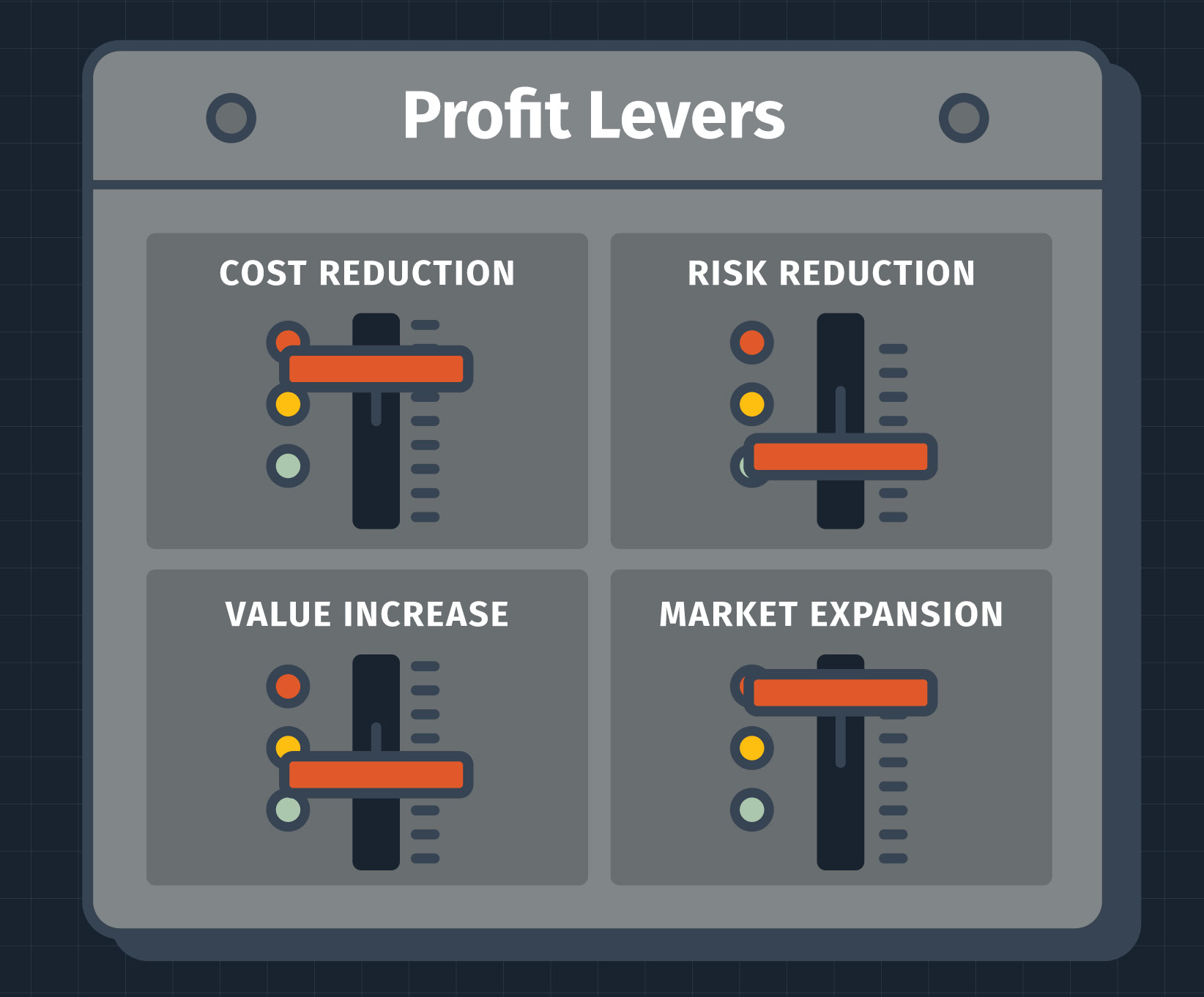
A Generic Menu of Software Profit Levers
Software contributes to an organization’s profit (a proxy for purpose) through a fairly finite series of levers related to service revenue and cost.
Cost Reduction is one of the most powerful and most obvious of the profit-levers that software can move. In this category, software can:
- Increase labor efficiency: Help individual workers to be more productive, onboard quickly, and make fewer mistakes; also streamline workflows across workers
- Automate activities: Replace human labor
- Optimize asset utilization: More value from each piece of equipment, resulting in fewer assets
- Shorten cycle times for key processes: Support quicker return on effort or investment
Risk Reduction is preventing and coping with anomalies in which the business fails to deliver what it promised to customers. Reducing risk prevents revenue decline and unplanned costs. Software can:
- Prevent anomalies: Increase the ability to foresee problems; enforce compliance and standards
- Detect anomalies: Identify anomalies or vulnerabilities before they become failures
- Accelerate recovery: Support faster recovery from incidents through better visibility and coordination
- Support learning from issues: Improve data integrity and traceability to support prevention, detection, and incident recovery
Value Increase is extracting more return from existing customers or existing solutions. This often results in pricing changes across the spectrum of customers. Software can:
- Increase quality: Grow reliability of the existing solutions in a way difficult to match by alternative solutions, so that the value increases and prices can be raised or maintained
- Increase value: Add new features, services, or customizations to existing products, so that the value increases and prices can be raised or maintained
- Facilitate tiered customer offerings: Support differentiated experiences by customer category or tier, allowing for differentiated pricing (and likely customer growth)
Market Expansion is extending the organization’s service footprint or category of offerings to reach new customers outside the current market. Software can:
- Expand service footprint: Provide new access to reach new customers
- Facilitate new opportunity discovery: Collect, house, and facilitate analysis of data so associates can discover insights and make better decisions, leading to customer growth.
Any software in a profit-seeking organization should exist to employ one or more of these profit levers. Lowe’s e-commerce site is for Market Expansion – Expand service footprint and for Cost Reduction – Automate activities. Warner Brothers uses application performance monitoring software to Reduce Risk – Detect anomalies. Capital One uses call center software to Reduce Costs – increase labor efficiency, Reduce Costs – automate activities, Reduce Risk – enforce compliance, Reduce Risk – support learning from issues, Increase Value – Increase service quality, Increase Value – support differentiated experiences. Software in an organization can embody multiple levers in support of the business purpose. The collection of profit levers that the software targets are the software’s purpose.
Software Profit Levers for Utilities?
So, how does this menu of software profit levers map to publicly-traded electric utilities? An electric utility exists to provide safe and reliable electricity to the customers in its service territory. These companies, such as Dominion Energy, Duke Energy, AEP, PG&E, and NextEra Energy are profit driven, but unlike most other for-profit companies, they operate within highly regulated markets where revenues, returns, and even allowable investments are largely determined by state and federal regulators rather than pure market forces.
Utilities can’t simply sell more products, raise prices freely, or enter new markets at will. This eliminates several of the profit levers available for these companies to deploy software against. Electric utilities can’t leverage software to support increasing prices for that electricity. They can’t differentiate pricing or service quality across customers (at least, not without regulatory approval). In fact, they generally cannot choose NOT to serve customers, even if they must do so at a net cost. Most regulated electric and gas utilities in the U.S. operate under a legal “obligation to serve.” This means they are required by law or by their state utility commission to provide reliable service to all customers in their defined service territory—even if serving some customers costs more than the utility can recover through rates.
As a part of this “obligation to serve,” electric utilities are granted a monopoly within a defined service area: they have to serve all of the electric customers in a geographic area, but they also own all the customers in that area, but only that area… they cannot use software to Expand their Market, unless new customers enter the geography.
In summary, utilities can’t raise prices or differentiate prices, they have partial control of cost reduction, and they can’t reach new customers outside a certain geography. They CAN reduce the risk of revenue loss and unexpected costs from anomalies and issues. And they CAN reduce costs through efficiency and automation, optimize asset utilization to some degree, and they can shorten cycle times for a quicker return on investment.
The Good Part About Regulation
Regulation severely limits a for-profit electric utility’s ability to grow or sustain profit. However, the tradeoff for regulation by the Federal Energy Regulatory Commission (FERC) comes with a key advantage: they are granted a guaranteed Return on Assets (assets include the equipment to make, transmit, and deliver electricity) as well as reimbursement of equipment operations, maintenance, and other costs. The Return on Assets (ROA) is proportional to the value of assets. The allowable costs and ROA are ultimately charged to power consumers, and are in addition to the cost of electricity purchased. That makes the profit formula different for these regulated for-profit electric utilities:
Profit = Return on Assets + Allowable Cost Reimbursement + (Units of Electricity Sold X (Price per Unit – Cost per Unit)) – Fixed Costs
Electric utilities are therefore incentivized to grow the base of assets (or “rate base”) – they can recoup the costs, and get a guaranteed return on assets that grows as the amount of owned equipment grows. This incentive might have led utilities to over-invest in equipment, but they are prevented from that by regulation: non-governmental entities called regional transmission operators (overseen by the Federal Energy Regulatory Commission) must approve decisions to modify or upgrade the transmission grid. They can’t just grow their equipment base as a means to grow profit.
However, electric utilities have two more tricks up their sleeves within the accounting and finance domains to increase profit. First, electrical equipment is purchased by borrowing money and by selling shares in the company (usually this split about 50/50). The company can grow profit on equipment investments by lowering interest rates or increasing the company share price. Both interest rates and share prices are driven in part by the company’s reputation for reliably fulfilling its purpose to provide electricity.
Further, the company can realize the return on investment sooner by shortening the time that purchased equipment is not in service. This includes shortening the period from borrowing or receiving investment for a piece of equipment to energizing the equipment, as well as shortening the time equipment is offline for maintenance. Equipment costs and return on equipment can only be recouped when the equipment is in service.
These two accounting and finance mechanisms allow utilities to lower Fixed Costs while they are pursuing higher Return on Assets.
And Finally, Software Profit Levers for Regulated For-Profit Electric Utilities
Regulated Electric Utility profit can come from customer growth (more customers or more use per customer), reduction in variable costs for providing electricity, and on a guaranteed-by-regulation return on assets. So let’s translate this to the profit levers that software can affect.
Cost Reduction for Utilities:
- Increase labor efficiency: only valuable if the labor cost wouldn’t be part of the Allowable Cost Reimbursement
- Automate activities: only valuable if the labor cost wouldn’t be part of the Allowable Cost Reimbursement
- Optimize asset utilization: only valuable if borrowing costs are greater than the guaranteed Return on Assets
- Shorten cycle times for key processes: very valuable to reduce the time between borrowing for equipment and putting that equipment in service, and to reduce the time equipment is out of service for maintenance.
Risk Reduction:
- Prevent anomalies: very valuable because continuing to reduce anomalies should reduce financing costs (because markets / lenders demand less return for companies it trusts)
- Detect anomalies: Very valuable as a means to lessen the impact of anomalies and thereby reduce financing costs.
- Accelerate recovery: Pretty valuable, but may be less valuable monetarily than prevention.
- Support learning from issues: Very valuable as a means to grow prevention capabilities.
Value Increase:
- Increase quality: Likely valuable. Increasing the quality of power (including reliability or voltage consistency) or other services (such as responsiveness) may be important to attract or retain certain customers (such as data centers or industry), but won’t grow the profit per unit of power. Note that growing the customer base will drive asset growth.
- Increase value: Likely valuable. Adding special support, options, or associated features could be valuable to attract or retain certain customers (such as data centers or industry).
- Tiered customer offerings: Regulation makes this very difficult.
Market Expansion:
- Expand service footprint: Very improbable (it isn’t useful to try to serve customers outside the service footprint with a website).
- Facilitate new opportunity discovery: Likely very valuable. As Energy Utilities continue to amass better data and develop skills and tools to better project current and future needs, they are likely to discover opportunities to implement grid changes that ensure reliability. These grid changes translate to Return on Assets.
To summarize, investments by regulated electric utilities in software to serve their purpose (and thereby grow profit) are most effective in two general domains: (1) logistics optimization and workflow to reduce the time that purchased equipment is not in service, and (2) monitoring, detection, data quality, data modeling, and data analytics to facilitate risk reduction and opportunity discovery. Both are Data domains.
Software to optimize logistics and workflow may include some user-facing software. Workflow software may support less delay between associate handoffs. It may align priorities across contributors, so work gets done faster. It may prevent balls from being dropped through notifications and work backlogs. Yet more powerful, however, is to use software modeling and analysis to optimize scheduling. Both construction and maintenance activities require estimates of time (when it is ready, how long it will take) across hundreds of contributors and vendors. Software can optimize scheduling to minimize wait time and downtime, and ensure the most valuable assets are in service as much as possible. This level of computational decision-making can’t be matched by humans without software.
Risk reduction and opportunity discovery through data modeling and analysis are likely the biggest revenue drivers. Through big data analysis, utilities are more able to discover future risks, and successfully argue for the necessity of doing the work with regional transmissions operators, who have the authority to limit excessive grid change. With data and data analysis tools, utilities can project hundreds of permutations of potential load growth and change across the grid, allowing for precise and highly defensible proposals to augment the grid.
Building data-rich software for these two domains leaves out many other uses for software that might save time for associates or facilitate customer service. I am certainly not arguing that those types of software shouldn’t be built. I would argue, however, that within the regulated electric utility industry, the highest priority for building software should be the software that best helps it meet its current and future purpose to provide safe and reliable electricity, and that software centers on Data.
Loved the article? Hated it? Didn’t even read it?
We’d love to hear from you.