

A recurring theme in both life and work is expectation versus reality, and how basing your understanding too much on previous patterns can blind you to the actual reality of a situation. When we encounter a familiar scenario, we naturally load up a blueprint of how things are supposed to work. Most of the time, this is helpful. But occasionally, that expectation obscures what is actually in front of us.
As a personal case study, I wanted to tie in an experience I had over Christmas. My sister had received a number of smart home devices as presents, including a few sets of 3-way light switches intended for the stairs. When installing these, we took the logical route: we initially installed them by keeping track of the connected wires on the old switches, hooking the new smart switches up to those exact same wires. We expected it to just work. Nothing fancy, nothing complicated.
Now, a little background on 3-way switches. Omitting neutral and ground for the sake of simplicity, a 3-way switch essentially has a “common” terminal and two “traveler” terminals. All the switch does is choose which traveler is connected to the common. In order to light our lightbulb, we need to close our circuit, connecting the line on one end of our 3-way switches to the line on the other side.
The way they work is very similar to railroad switches. Let’s start with our circuit, a simple oval loop of train track. In our analogy, let’s make our light bulb a train station, and our power source a second train station. The light bulb station removes cargo from the train, and the power source station adds a new shipment. Let’s put these on one side of our oval train track.
On the other side, we add our switches. We take the rail that leads from the power source station and add a switch that acts as a fork in the rail: it decides whether the train will travel down a parallel red rail, or a black rail. At the end of these parallel rails, we place our second switch, which decides whether to connect the red rail or the black rail back into the single track leading to the light bulb.
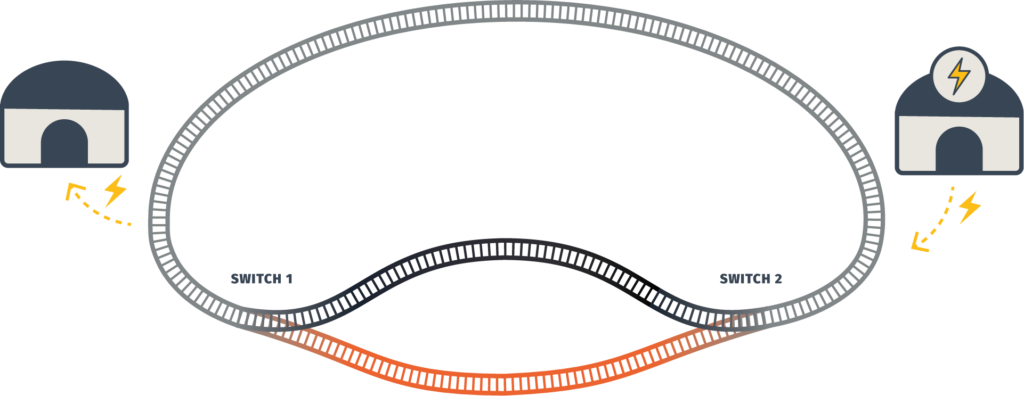
Before the power source station will send a train with cargo toward the light bulb station, it makes certain there is a clear path to get there. This means that if the first switch sends it onto the red rail, and the second switch accepts the red rail, it sends the train. If they both use the black rail, it sends the train. But if the first switch sends it on the red rail, and the second switch accepts the black, the train would derail, and so the power source station refuses to send the train. Regardless of what is selected by switch one (red or black), switch two can always affect whether the train will be accepted back or not. This is why flipping either switch on a 3-way circuit can toggle the light on or off, entirely independent of the other switch.
That is how 3-way switches are intended to work, and how anyone familiar with them might expect them to be connected. But when we went to test the light, we noticed some odd behavior. If we toggled one switch to turn the light off, the other switch could not turn the light back on. This worked both ways.
The reason this behavior might go unnoticed for years is that if one old, “dumb” switch is left in the position that allows the light on, and just goes unused, the other switch behaves exactly like a normal light switch. No one is the wiser. With a smart switch, though, it kind of just chooses one to toggle, expecting standard behavior. Instead, it behaved rather erratically and would sometimes alert about a disconnected switch. In any case, we sought to identify the source of the issue.
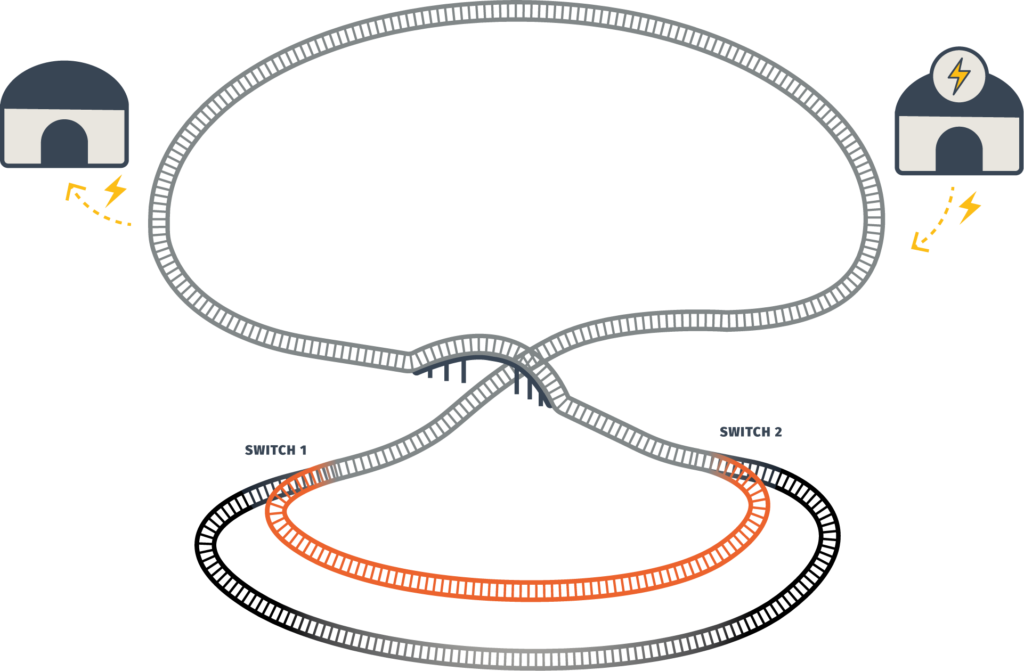
The behavior turned out to be the result of some confused wiring on the top switch. Rather than delve into the actual wiring, let’s return to our railroad example. This time, imagine the connections of the black rail and the source feed rails are reversed. The rail from our power source bypasses the first switch entirely and connects directly to the second switch, right where the black rail used to go, merging with the red rail. Now, the black rail connects to the output of the second switch, acting as a return track that brings the train backward to the input of the first switch. At that first switch, the track splits: one path leads to the rail for the light, but the other path connects to the opposite end of the red rail. Because of this, the red rail isn’t a parallel track anymore, it forms an isolated loop between the two switches. By expecting the standard parallel configuration, we were largely blind to the actual mess of what was actually in the wall.
Once we figured it out, we started noticing crossed wires in other places. Later, we found a 3-way switch being used in place of a normal switch for a simple porch light. At my older brother’s house, he encountered a setup where both switches had to be flipped “on” for the light to come on because one traveler wire was simply never connected.
In the realm of home wiring, these mismatched expectations usually stem from simple misuse. But in the professional world, this same disconnect happens frequently, sometimes because of errors, but often because of differing priorities and objectives.
In our efforts to integrate GIS and network models for the power grid, we see how different data sources have different objectives with their data. GIS data from the HIFLD (Homeland Infrastructure Foundation-Level Data) focuses heavily on how lines connect different substations. Open source and community-contributed maps, on the other hand, may focus more on where there is infrastructure (where the power lines and substations physically sit), but don’t have a particular focus on representing how it is connected. As such, some features may be grouped together based more on location than the actual relational properties of the infrastructure.
In tasks like these, it is important to recognize that the expectation of how something should be used, represented, or configured, may not line up with how someone else expected it to be used, represented, or configured. In our light switch case, that happens to be because of misuse, but in real-world cases, it can often come down to a difference in priorities or perspectives that lead to multiple valid interpretations of an objective that fail to match up. Ultimately, whether you are wiring a three-way switch or modeling a power grid, the most important tool you have is the ability to step back, let go of the pattern you expected to see, and evaluate the reality of what is actually there.
Loved the article? Hated it? Didn’t even read it?
We’d love to hear from you.