
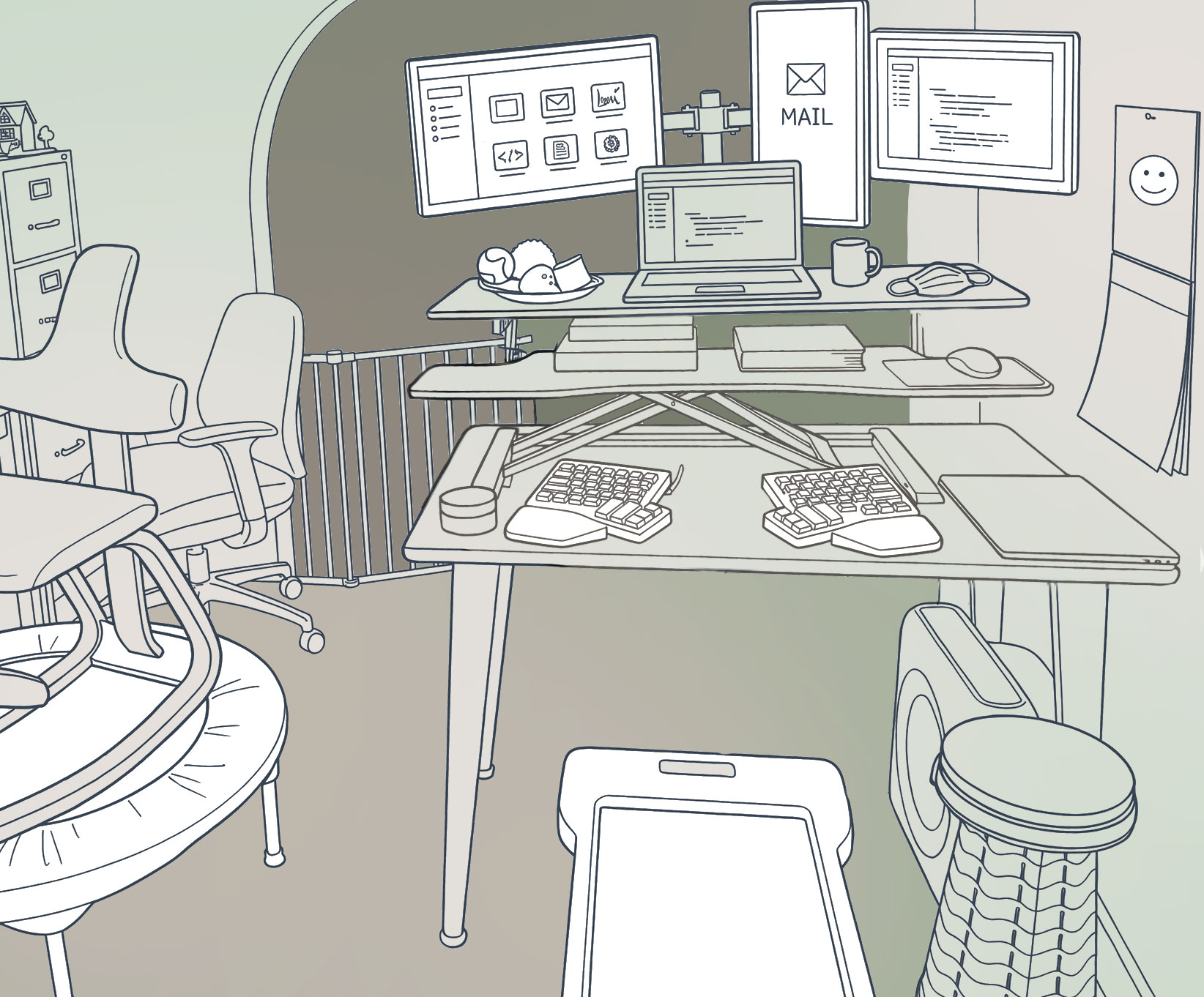
I recently saw a post about someone who had converted their entire basement into a complex system that would make it easier for them to manage their laundry. It really got me thinking about the ways I’ve modified my own environment to support my needs.
I have ADHD, which I didn’t learn until my mid-30s. I probably also have autism (commonly referred to as AuDHD when you have both). I have been adapting things to work better for me my whole life…often when I encounter a list of tips to help manage ADHD (e.g. color-coding, visual reminders), there is more recognition than inspiration: I’ve been doing a lot of that stuff for years.
Before I knew that my brain was wired differently than the average person’s, I really struggled. There was a lot of confusion and anger: “why can’t I just???” accomplish the things I wanted to do. Since I got good grades in school, I was seen as smart, so I didn’t know why things could be so difficult for me sometimes.
Now, this understanding of how my mind works is a powerful new lens or framework I can use to look at the problems I run into. There is more clarity around what might be the root cause of an issue, because often it is a struggle that other people with AuDHD also have. Instead of burning all my energy trying harder, I can try differently. Most importantly, instead of inflicting shame and blame on myself, I can see things more neutrally: not as personal faults or failings, but simply limitations I have to deal with. And, I wouldn’t actually want my brain to be any other way…there are a lot of fascinating and delightful things about it.
Overall, I see my AuDHD as a strength at work. I’ve seen it described as thinking like a graph, not in a straight line. My brain is a vast web of connections, and I can relate things to each other in unique ways, and see things with a different perspective. I’m not afraid to question things: just because we always did it this way, does it make sense to continue?
But I have noticed that my environment has a strong effect on my ability to do my best work. In the past, I really struggled to work in an open office. My first coding job had an engineering office, with maybe 10 people or so. But then they built this beautiful new giant room to be shared by all of the office staff, open to the sounds and smells of the kitchen.
I would literally hide under my desk with my laptop to try to focus. People thought it was funny, but I was really struggling to close out all the distractions. That was before I knew about the AuDHD, so I just tried my best to power through it.
Now, I consider myself very lucky to work from home full time.
I can control the noises in the room, whether it’s music from my speaker or silence. I don’t like the feeling of wearing headphones on my head, and when I was in an office, they never blocked out all the distracting sounds for me anyway.
I don’t have to mask, or hide behaviors that other people may find odd. I can talk to myself, either exclaiming aloud when I have a strong emotional reaction to something, or I will sometimes have back and forth conversations out loud about what to do next with my code. I might sing little bits of songs over and over.
I have decorated my desk with as many knickknacks, fidget toys, crystals, and glittery/iridescent/shiny things as it can hold. I am a “visual seeker”…I like to have a lot of visual input, and feel uncomfortable if things are too sparse. Every time I see one of the special items I’ve carefully arranged on my desk, I get a sparkly little feeling of delight. Having my entire workstation just as I want it to look makes me feel calm and happy, and helps counteract anxiety.
I have a dish that is overflowing with fidget toys. Being able to pick up something and give my hands something to do in a meeting helps me stay focused and relaxed.
There are two external monitors that I connect to. Having more screen real estate than just my laptop especially helps in meetings: I can have the call window open but also another window for my notes, both to reference or write. If we are discussing information relevant to me, I’m almost constantly typing notes, which helps slow my mind down to stay with what is happening in the present moment. It’s also a valuable reference later, because I often struggle to remember things.
I can also wear clothes that wouldn’t be office-appropriate, like running shorts. It is common for people with ADHD to struggle with the transitions in between tasks. For me, being able to get dressed in my running outfit at the start of the day makes it much more likely that my after-work run will actually happen. I’m also just more comfortable wandering around my house barefoot.
I have a split keyboard because it feels so much better on my wrists and hands than a rectangular one.
Instead of having to pack all the components in my lunch, an extra step in a process I already struggle with (the tedium of meal planning and cooking), I have access to my entire fridge.
My team is really great, but my dog is my favorite coworker. Being able to look over and see her curled up so adorably on the couch brings me a lot of joy. If I am doing something particularly stressful, I can sit next to her, and it helps me stay calm and regulated. We’re both happier that I can spend most of my lunch break going on a walk with her, instead of frantically commuting home from an office to let her out briefly.
One of the most important tools that helps me keep my thinking sharp is movement. Back when I was in code school, I would arrive about an hour early to beat traffic, and I’d go for a long walk around the city. Then, at lunch, I’d feel compelled to go for another long walk, and I had no idea why. That was before I knew about the ADHD and how helpful exercise can be for it.
I do my best work on a treadmill at a low speed. Whether I’m walking through a meeting, or in that flow state writing code, jamming out to my current favorite song on repeat, the difference between that and trying to make myself sit in a desk chair all day is incredible.
I generally spend about 5 hours a day walking, and then I can lower my desk and sit in a rocking chair, which is more restful but also allows for soothing movement. That chair actually fits right on top of my treadmill, so it is an easier transition than it would be to have to move the treadmill every time.
Recently, I got a small trampoline, and I absolutely love it. I bounce to a favorite song just before starting the workday to get my energy up and get myself into a positive mood. Unfortunately it doesn’t fit over the treadmill, so I only use it for meetings or short stretches of time where I won’t need my monitors and keyboard. It can be a nice change of scenery.
I feel like now, I have my system pretty well dialed in. But it has been a years-long process of iterating and experimenting with different things. My first standing desk was a bunch of cardboard boxes taped together on top of my regular desk. Then I tried bringing a simple balance saucer to the office. I noticed that some people, if they wanted to try it, would really struggle and have to hold onto the desk. Since it was so easy for me to balance on it and do everything I needed to do, I had confidence that I’d be able to handle walking on a treadmill and working at the same time. Some things have not worked out, like the slackline-inspired balance board which, unless I get significantly more practice with it, I can’t use for work because I would be wildly flailing about.
Whether or not you are neurodivergent, or work from home, here are some things to consider:
- Is there anything that you could do to bring more joy and delight to your workspace?
- Do you have something you can see from your desk that you find beautiful to look at?
- Are there ways you could introduce more movement into your day?
- Can you incorporate something familiar and relaxing into your space? What about some novelty and excitement?
- If you can control the sounds in your environment, have you noticed a difference in your energy when they fit your mood or focus level? What about other sensory considerations like temperature, or the clothing you’re wearing? Can you adjust for more comfort?
- Can you set things up to make transitions between tasks easier?
Loved the article? Hated it? Didn’t even read it?
We’d love to hear from you.




Designing a workspace that works for you is so important for focus. I also find that offloading mental clutter helps; I use Taskai on my Android to capture tasks instantly so they don’t distract me from my deep work.
Yes, I have a very detailed system in Obsidian for my notes and to-dos.
Have you ever read “The Speed of Dark” by Elizabeth Moon? I bet you’d like it.
I have not! I’ll see if it’s at the library!