
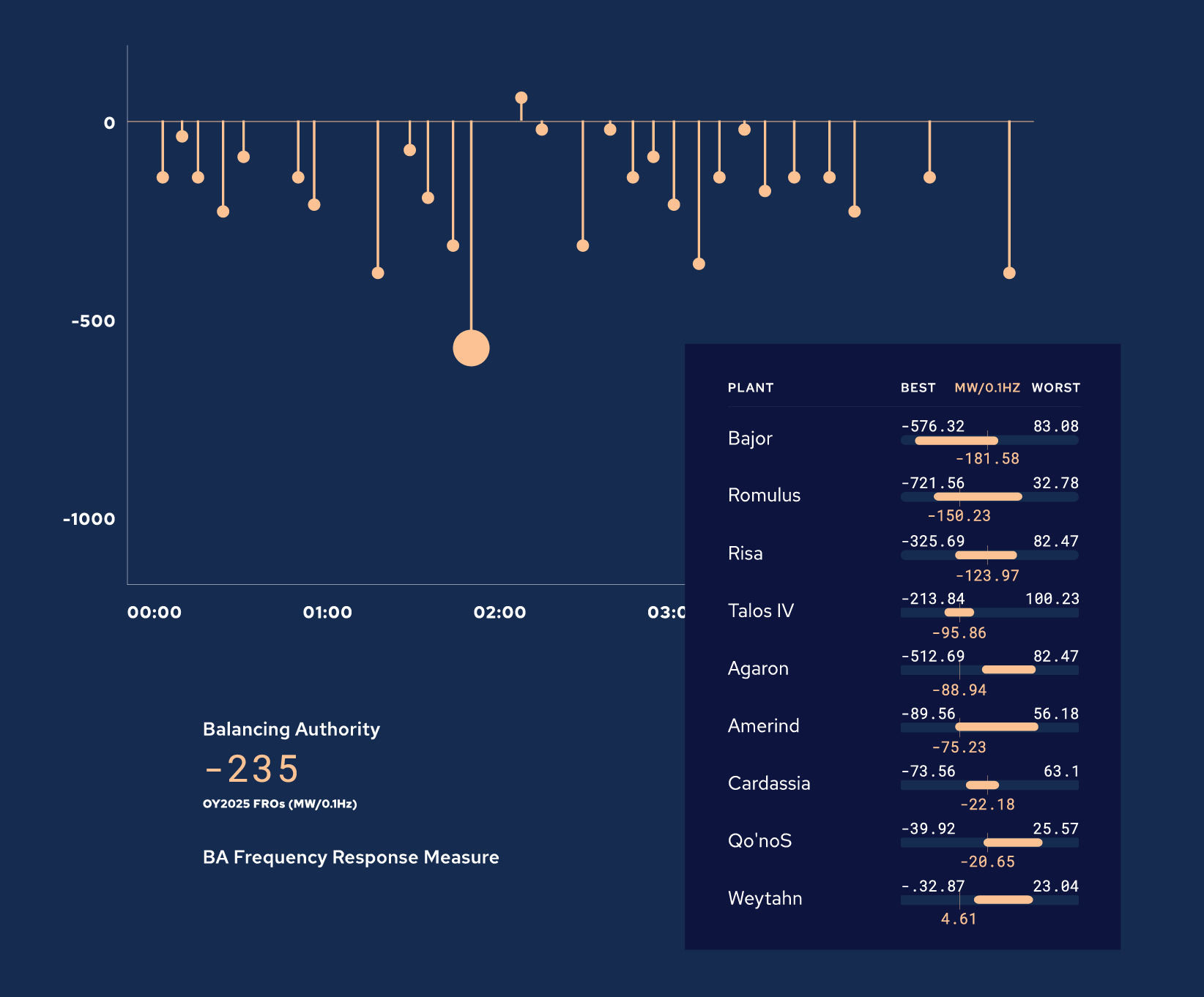
The stability of the electric grid relies fundamentally on maintaining two key parameters: frequency and voltage. These must stay within tight operational bounds to prevent cascading failures, blackouts, or equipment damage. When disturbances occur, such as a large generator unexpectedly tripping offline, a massive load disconnecting abruptly, a transmission line fault, or a capacitor bank switching, the grid experiences deviations in frequency or voltage.
In response, power plants must automatically adjust their active power (to counteract frequency changes via primary and fast frequency response) and reactive power (to support voltage stability through automatic voltage regulation or reactive power control). These local, autonomous control actions, governed by droop curves, governors, exciters, and inverter controls, form the bedrock of grid reliability. They enable the system to arrest deviations quickly, often within seconds, and restore balance before protective relays trigger under-frequency load shedding (UFLS) or under-voltage load shedding (UVLS), which could otherwise lead to widespread outages.
The Limits of Traditional Generator Performance Verification
Historically, verifying whether generators are responding correctly and precisely in line with their design expectations and interconnection agreements has been a labor-intensive, manual undertaking. Engineers would isolate a specific disturbance event from event logs, gather relevant high-resolution data (often from Phasor Measurement Units (PMUs)), run detailed offline simulations, and painstakingly compare simulated versus measured behaviors point by point.
This post-event, model-based approach, while thorough for critical investigations, is resource-heavy, prone to human error in data handling, and struggles to scale in modern grids. Today’s systems face frequent disturbances, vast fleets of generating units (hundreds to thousands per balancing authority), and increasing variability from renewable sources, making comprehensive manual review unsustainable.
Power systems are evolving rapidly, with the growing penetration of inverter-based resources (IBRs), including wind turbines, solar photovoltaic (PV) arrays, and battery energy storage systems (BESS), introducing fundamentally new dynamics. Unlike traditional synchronous generators, which provide inherent rotational inertia and respond via mechanical governors and exciters, IBRs rely entirely on fast-acting electronic controls and power electronics. This enables sub-second responses but can lead to different behaviors during disturbances, such as potential over-response, under-response, or even unintended tripping if controls are misconfigured.
Utilities, balancing authorities (BAs), and grid operators urgently need scalable, measurement-driven methods to continuously monitor and evaluate generator performance across entire fleets in near-real time. High-resolution, time-synchronized data from PMUs, delivering frequency, voltage and current at up to 60 samples per second, and supervisory control and data acquisition (SCADA) systems provide the raw visibility. The true game-changer is intelligent automation that transforms this flood of data into clear, actionable insights without overwhelming engineering teams.
Why Automation Is Essential in Modern Grid Operations
Traditional evaluation methods simply do not keep pace with grid realities. Disturbances can now occur multiple times daily due to large penetration of IBRs, growing load diversity, and aging infrastructure. Fleets often encompass hundreds or thousands of units, with a rising share of IBRs that require ongoing verification of ride-through, frequency response, and reactive support capabilities. Manual analysis for each event is impractical, leading to delayed identification of underperforming assets, control misconfigurations, or model inaccuracies, issues that can compound during major events.
Balancing authorities carry direct regulatory responsibility for ensuring adequate system-wide frequency response and validating that generator models reflect real-world performance. These obligations intensify as renewable variability increases and resource diversity expands, demanding proactive monitoring rather than reactive firefighting.
Regulatory frameworks make robust, automated performance monitoring non-negotiable. NERC Standard BAL-003-2 (Frequency Response and Frequency Bias Setting) mandates that each BA (or Frequency Response Sharing Group) achieve an annual Frequency Response Measure (FRM) equal to or less than its allocated Frequency Response Obligation (FRO). The FRO quantifies the required MW per 0.1 Hz response to maintain interconnection frequency within defined limits and prevent UFLS. Interconnection Frequency Response Obligations (IFROs) are allocated among BAs and adjusted annually based on factors like resource loss protection criteria, load resource credits, and historical performance.
Complementing BAL-003-2 is NERC’s Primary Frequency Control Reliability Guideline (Version 4.0, updated September 2023, with ongoing relevance). Though not mandatory, it disseminates best practices for delivering Primary Frequency Control (PFC) or Primary Frequency Response (PFR). It stresses automatic detection of frequency deviations and proportional power adjustments to arrest declines. For IBRs and BESS, it tackles unique challenges: wind and solar often run at maximum output to maximize revenue, lacking upward headroom for under-frequency events unless pre-curtailed. BESS controls can err by freezing setpoints; if charging during a drop, the battery may simply stop rather than inject. The fix is additive PFR logic, where the response signal overlays the base dispatch setpoint, ensuring contribution regardless of prior mode (charging, discharging, idle). This directly supports BAL-003-2 compliance and capabilities required under federal rules.
FERC Order 842 (2018) mandates that all newly interconnecting facilities, synchronous and non-synchronous, equip and operate governors or equivalent controls for autonomous PFR, with droop settings based on nameplate capacity and no exemptions for operating state. It provides the regulatory “what”, while NERC guidelines offer the “how”.
FERC Order 901 (2023) directed NERC to develop comprehensive IBR reliability standards over three years, addressing gaps like fault ride-through (preventing mass tripping), data sharing, model validation, and performance during disturbances. Progress has advanced steadily: by late 2025, NERC filed Milestone 3 standards with FERC. These build on IEEE 2800-2022 for technical interconnection details, turning voluntary practices into mandatory obligations. Additional projects (e.g., planning/operational studies with IBRs) continue into 2026. As PMU deployments grow via initiatives like NASPI, high-resolution data enables large-scale automation, if events are detected reliably and responses evaluated objectively.
Transforming Raw Data into Actionable Metrics
Purpose-built tools leverage PMU and SCADA time-series data to:
- Detect frequency and voltage excursions in real time or near-real time.
- Accurately estimate event start times amid measurement noise.
- Quantify individual generator and aggregate BA responses using standardized metrics.
- Assess consistency with expected control behaviors (e.g., droop curves).
Core metrics include the Frequency Response Measure (FRM) for active power adjustments, verifying if PFR is enabled, appropriately sized (e.g., matching droop percentage), and sustained (not just initial spike). Droop evaluation plots frequency deviation against power change to confirm linearity and deadband compliance. For voltage, the Voltage Response Measure (VRM) quantifies reactive power injection or absorption during events like capacitor switching, ensuring local voltage stability. Additional features track voltage schedule adherence under varying time-of-day or load conditions.
These measurement-based insights differentiate well-configured but constrained units (e.g., solar at max output with no headroom) from those with genuine control issues needing tuning, or model recalibration. The shift from reactive, event-specific studies to proactive, continuous fleet monitoring saves thousands of engineering hours, improves NERC compliance, and enhances overall situational awareness.
Introducing Aion Pulse
At Simple Thread, we are proud to deliver this capability through Aion Pulse, our commercial evolution of the Generator Scorecard developed by the Pacific Northwest National Laboratory (PNNL), funded by the U.S. Department of Energy’s Office of Electricity. Field-tested successfully (e.g., December 2023 at BPA’s Synchrophasor lab monitoring 22 plants across traditional hydro/thermal and renewable resources), the tool automates analysis using PMU data for fast, objective insights.
We have partnered closely with PNNL to transition this powerful research tool to make it production-ready. Our team, blending deep power systems domain knowledge with modern software engineering, user-centered design, and scalable architecture, has refined Aion Pulse to be robust and intuitive.
Key capabilities include:





The tool reduces engineer workload, pinpoints issues early, and enhances NERC compliance by providing objective, fleet-wide insights. It aids prioritization: high-performing plants need minimal scrutiny, while inconsistent ones trigger deeper validation or tuning. Through our collaboration with PNNL, this isn’t just another tool, it’s engineered by people who understand both the grid and the software needed to support it.
The Path Forward for Grid Reliability
Automating generator performance evaluation marks a true paradigm shift. By harnessing PMU/SCADA data, tools like Aion Pulse convert raw measurements into standardized, real-time indicators for enhanced awareness, faster resolution, and reliable integration of diverse resources in dynamic grids.
As IBR penetration increase and large variable loads grow, measurement-based automation becomes indispensable for meeting evolving regulatory mandates, optimizing controls, preventing hidden reliability risks, and sustaining a resilient grid.
At Simple Thread, we are committed to building software that empowers utilities to navigate these changes efficiently and confidently.
How does your organization currently track generator performance and overall balancing authority performance?
Loved the article? Hated it? Didn’t even read it?
We’d love to hear from you.