
“Move Fast and Break Things” Doesn’t Work on the Grid
In the tech world, the standard advice is to “move fast and break things.” But if you manage critical energy infrastructure, that is terrible advice. If a consumer app glitches, it’s annoying. If a power system application glitches, it’s a crisis.
This is why many energy executives are cautious about rushing AI into production. They have good reason to be. A recent analysis conducted with the Wharton School found that the biggest roadblock for corporate AI isn’t building a working prototype; it’s actually transitioning that prototype into enterprise-wide deployment [1]. Teams are building cool tools in a sandbox, only to realize they can’t clear the regulatory, security, or safety hurdles required for the real world.
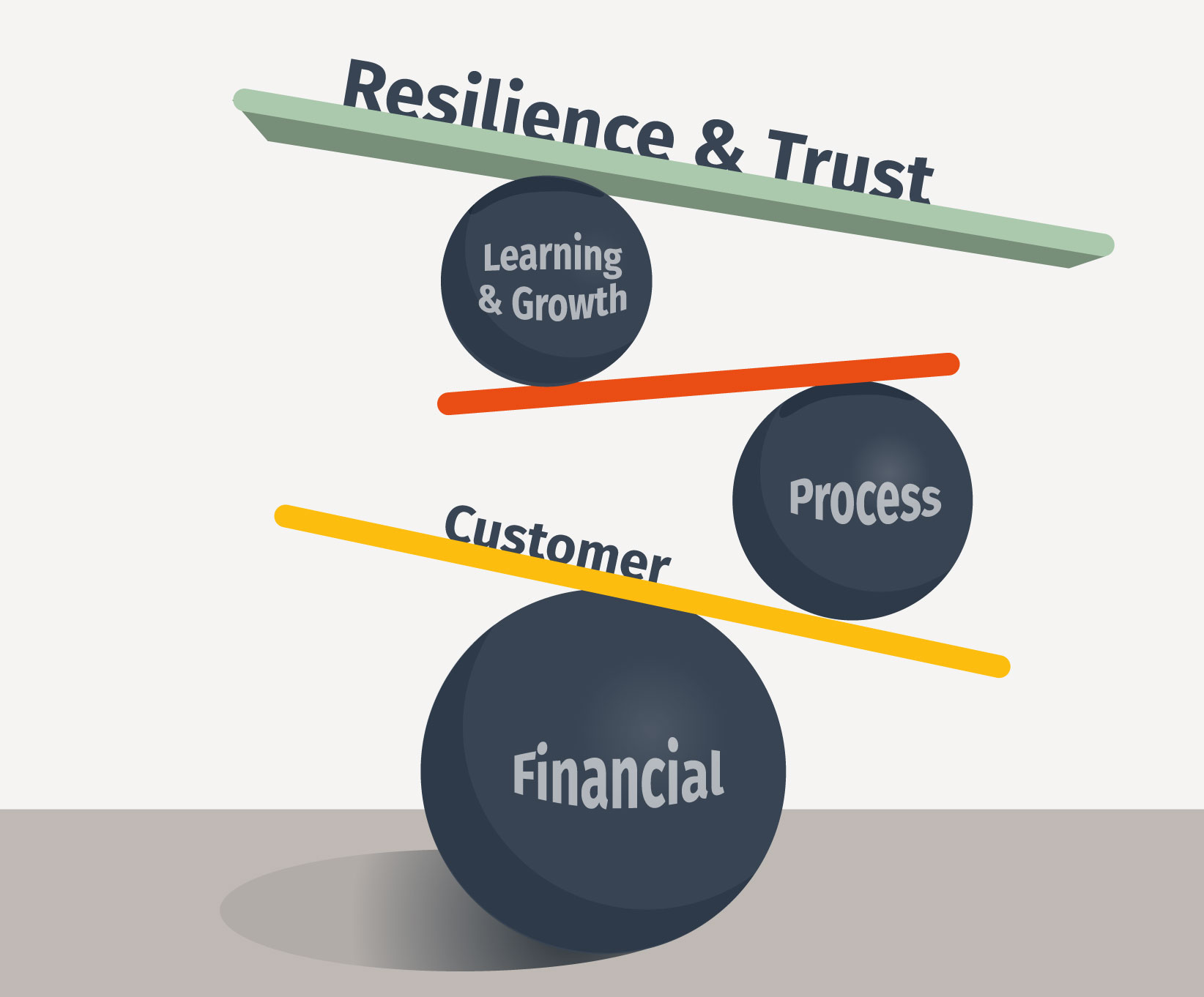
The Balanced Scorecard [2] was originally built to solve this exact kind of organizational disconnect. Back in the ’90s, Robert Kaplan and David Norton realized that companies were focusing too much on short-term financial numbers and ignoring everything else. Their framework forced organizations to look at four areas at once: finances, customers, internal processes, and long-term growth. The goal was balance, making sure speeding up one department didn’t accidentally break another.
Right now, AI adoption is wildly out of balance. Companies are grading themselves almost entirely on how fast they can build new software tools (the internal process lens). But in high-stakes industries, if you don’t factor in long-term reliability and compliance from day one, you just end up wasting time and money.
The Graveyard Nobody Audits
In high-stakes industries, the most common AI failure mode isn’t a disastrous public launch. It’s that there is no launch at all. Features die in security reviews. Integrations stall during compliance assessments. Proposals get tabled because no one can honestly answer what happens when the model makes a mistake.
Think about the people keeping the lights on. In the energy sector, an AI “hallucination” isn’t a minor customer service hiccup. Caution isn’t bureaucratic red tape, it’s an operational responsibility.
Under traditional management accounting, this hesitation creates a massive blind spot. There is no incident report for an AI feature that never ships. There’s no postmortem or lesson-learned entry in a project tracker. The Balanced Scorecard records absolutely nothing.
Meanwhile, the cost is incredibly real. Engineering hours are wasted, and organizational trust in AI quietly erodes. The graveyard fills up, but nobody audits it because our tracking systems weren’t built to see it.
The Fifth Lens: Resilience and Trust
To fix this, we need a shift in mindset. We have to stop viewing safety, security, and compliance as “friction” that blocks AI, and start seeing them as the actual foundation for it. Energy leaders aren’t anti-AI; they are just appropriately protective of systems that require absolute exactness.
By 2030, I predict mature organizations will formalize this by adding a fifth lens to their Balanced Scorecard: Resilience and Trust.
This lens wouldn’t give compliance a bigger veto stamp to slow things down. Instead, it would force organizations to account for the “sunk risk” of engineering hours spent on unlaunchable features. It brings the hard governance questions to the front of the line, before the first line of code is written.
Managerial accounting has an old concept called relevant cost thinking. The basic idea is that to make a good decision, you ignore past costs and focus entirely on what changes moving forward. If we applied that here, we’d ask:
- What is the actual exposure to the grid if this AI application fails?
- What happens to public trust if physical safety is breached?
- What happens when a model produces a confident wrong answer and no human catches it?
A fifth lens doesn’t slow teams down. It stops them from building things they can’t legally or safely deploy. By pulling invisible risk into a clear structure, it allows the industries powering our world to innovate safely instead of being too afraid to innovate at all.
Sources
[1] Risk & Insurance Editorial Team. (2026, June 4). AI Liability Is No Longer a Future Problem for Risk Managers (Featuring analysis conducted with the Wharton School of the University of Pennsylvania). Risk & Insurance. https://riskandinsurance.com/ai-liability-is-no-longer-a-future-problem-for-risk-managers/
[2] The Balanced Scorecard—Measures that Drive Performance. (1992). https://hbr.org/1992/01/the-balanced-scorecard-measures-that-drive-performance-2/
Loved the article? Hated it? Didn’t even read it?
We’d love to hear from you.