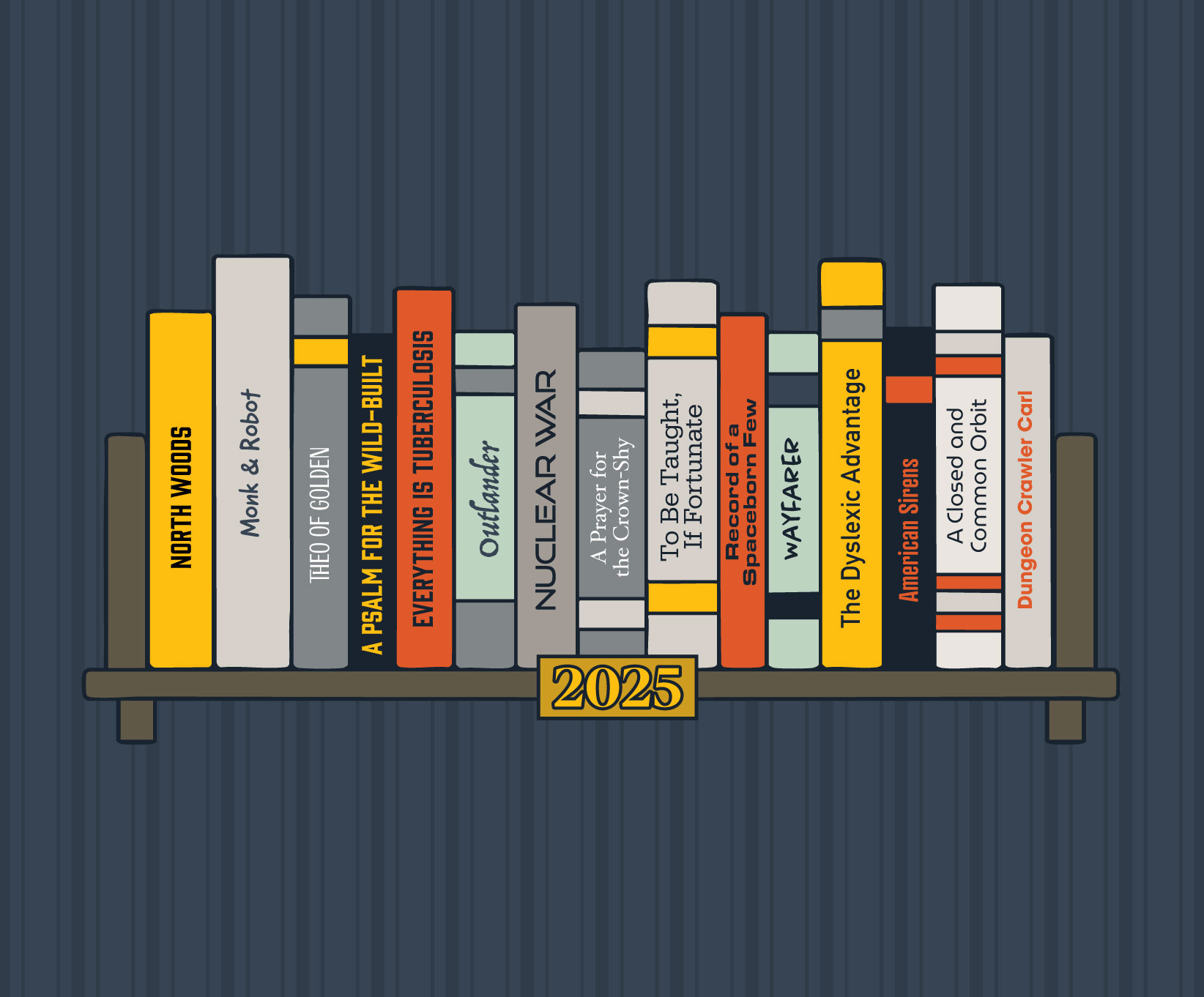
Books read, not necessarily published, in 2025
The Simple Thread team has had an incredible year of building, research, and community — and through it all, our reading list has grown right alongside us! This year’s favorites span from cozy sci-fi to deeply researched history and essential psychological insights.
As the year wraps up, we’re excited to share the books that captivated us, challenged our thinking, and provided a welcome dose of escapism. We hope you find your next great read among these team-chosen gems.
The Monk & Robot series and Wayfarer series, both by Becky Chambers
Team Member: Chris Ferdinandi
Why We Love It: Where most sci-fi books focus on external challenges that are big in both scope and scale, both of Becky Chambers series’ focus on more mundane, inner problems: finding meaning when the things that once brought you joy don’t anymore; figuring out who you are when the world around you is changing; navigating interpersonal conflicts. At a time when traditional sci-fi books feel less like escapism and more like doomerism, Becky Chambers’ books offer an alternative. They’re like cozying up with a cup of warm tea on a rainy day, and sometimes, that’s exactly what you need.
North Woods by Daniel Mason
Team Member: Robert Beatty
Why We Love It: My co-workers here at Simple Thread are probably tired of me suggesting this book, but they’re also presenting me with another opportunity to do so and I’m going to capitalize on it. This book is hard to describe. To share my personal testimony, I’ll say that I stayed up until 2AM one night finishing it and immediately started the audiobook version of it the next day because I had to relive the experience while knowing how the story plays out. North Woods tells a tale where a specific location is the main character. It’s the story of a single tract of land in the Pioneer Valley of Massachusetts, sharing its history through all of its inhabitants spanning 400 years. I laughed, I pondered, I cried, this book made me do all of the emotions and I hope it does the same for you.
Theo of Golden by Allen Levi
Team Member: Lauren Davis
Why We Love It: I loved this book because it’s a powerful reminder to lead with kindness – you never truly know what someone has lived through or is carrying with them.
The story follows Theo, an elderly Portuguese man who arrives in the small town of Golden as a mysterious stranger. He begins buying portraits displayed in a local coffee shop and returning them to the people depicted. It’s a simple act, but one that sparks unexpected connections and reveals how compassion and curiosity can profoundly shape both individuals and a community.
Theo’s world encourages you to ask questions, learn someone’s story while you have the chance, and notice the beauty in the small, everyday things around you. It’s the kind of book that lingers long after the last page – nudging you to be a little softer, a little more attentive, and a little more grateful.
Everything Is Tuberculosis: The History and Persistence of Our Deadliest Infection by John Green
Team Member: Justin Etheredge
Why We Love It: I love history books that weave together history and human connection. This book is exactly that. At the surface it is a book about the oldest known human disease, Mycobacterium tuberculosis. It is a pathogen that has killed more people than any other infectious agent in history. But while the history of TB is fascinating, what will really pull you in is the story of Henry, a young man Green met at a hospital in Sierra Leone in 2019.
Henry was suffering from a drug-resistant form of tuberculosis, a condition that is medically curable in wealthy nations but remains a frequent death sentence in poorer ones. By documenting Henry’s precarious journey toward recovery, Green grounds the narrative in this deeply personal friendship. Henry is not just a faceless patient, but is a young boy trapped in a TB treatment ward who loves his mom, loves soccer, and desperately wants the chance to grow up and experience life.
To understand Henry’s predicament, Green traces the bacterium’s influence across millennia, revealing it as a cultural force that has fundamentally shaped our world. He explores the contrast between the disease’s past and present. How it was once glamorized in the 19th century as a sign of “poetic sensitivity” that influenced opera and literature, versus its brutal modern reality as a “disease of poverty” that thrives where systems fail.
Green uses this history to drive home a sobering argument, tuberculosis is no longer a technological problem, but a social one. We have possessed the cure for decades. Its persistence as the world’s deadliest infection is not a failure of medicine, but a result of human choices about how we allocate our resources, and by extension, who we believe “deserves” to survive.
The Dyslexic Advantage by Brock and Fernette Eide
Team Member: Josh Williams
Why We Love It: This book should be a tremendous encouragement to anyone who is dyslexic or has dyslexic friends or family. The thesis of the book is that the same neurological wiring that produces the information processing and linguistic challenges that are the hallmark of dyslexia also produce certain distinct strengths. The authors call them “MIND” strengths—MIND being an acronym for Material Reasoning, Interconnected Reasoning, Narratival Reasoning, and Dynamic Reasoning— and these strengths can be expressed almost to the degree of superpower. The book alternates between neurological summary, quantitative research, and anecdotal testimonials of dyslexics who have identified these strengths within themselves, the sum effect of which has given my family handles to hopefully and determinedly navigate the severity of dyslexia within our own family. I would highly recommend this book to anyone, if for no other reason than to shift one’s own epistemological assumptions (our understanding of how we know things) and to appreciate the variety of neurological giftings expressed in our neighbors.
The Outlander Series by Diana Gabaldon
Team Member: Gwendolyn Schorling
Why We Love It: Most people know Outlander from the sultry TV show, but honestly the books are where it’s at for me. I completed the audiobooks this year—374 hours worth—and a big reason is the narrator. She’s fantastic with all the languages and accents.
What I love most is how strong the relationships are. They’re not perfect or cheesy, just deeply loyal and full of heart. And the history! It’s so immersive, especially because Claire is a 20th-century doctor dropped into the 18th century. Listening to her try to use modern knowledge in a world that doesn’t always want it is endlessly fascinating (and a bit gorey).
If you’ve only watched the show, the books go way deeper. Now I’m just waiting (impatiently) for the last book’s release date to be announced.
Nuclear War by Annie Jacobsen
Team Member: Tracy Simpson
Why We Love It: Stumbling across this book on a list of the “scariest books ever,” I was unprepared for how deeply unnerving it would be. It is a matter-of-fact, real-time accounting of everything that would happen following a missile launch. It covers the cascading consequences for the power grid, citizens inside and outside cities, the government, and the long-term aftermath. This was the one book I read all year that I simply could not put down.
Bonus Book Love
Dungeon Crawler Carl by Matt Dinniman
Team Member: Al Tenhundfeld
American Sirens by Kevin Hazzard
Team Member: Justin Beck
We hope this list gives you some great ideas for your own reading list as you head into 2026. Reading widely and continuously challenging our perspectives is key to our team’s approach to innovation and problem-solving, particularly as we work to accelerate a cleaner, more reliable energy future.
Loved the article? Hated it? Didn’t even read it?
We’d love to hear from you.