
Some of the most promising ideas in the energy industry begin as research.
But proving that a new method works is only one step toward changing how utilities operate. To make an impact at scale, that research eventually has to become software that engineers can deploy, understand, trust, and incorporate into their existing workflows.
That transition is at the heart of Simple Thread’s work with Pacific Northwest National Laboratory (PNNL) on Aion Pulse.
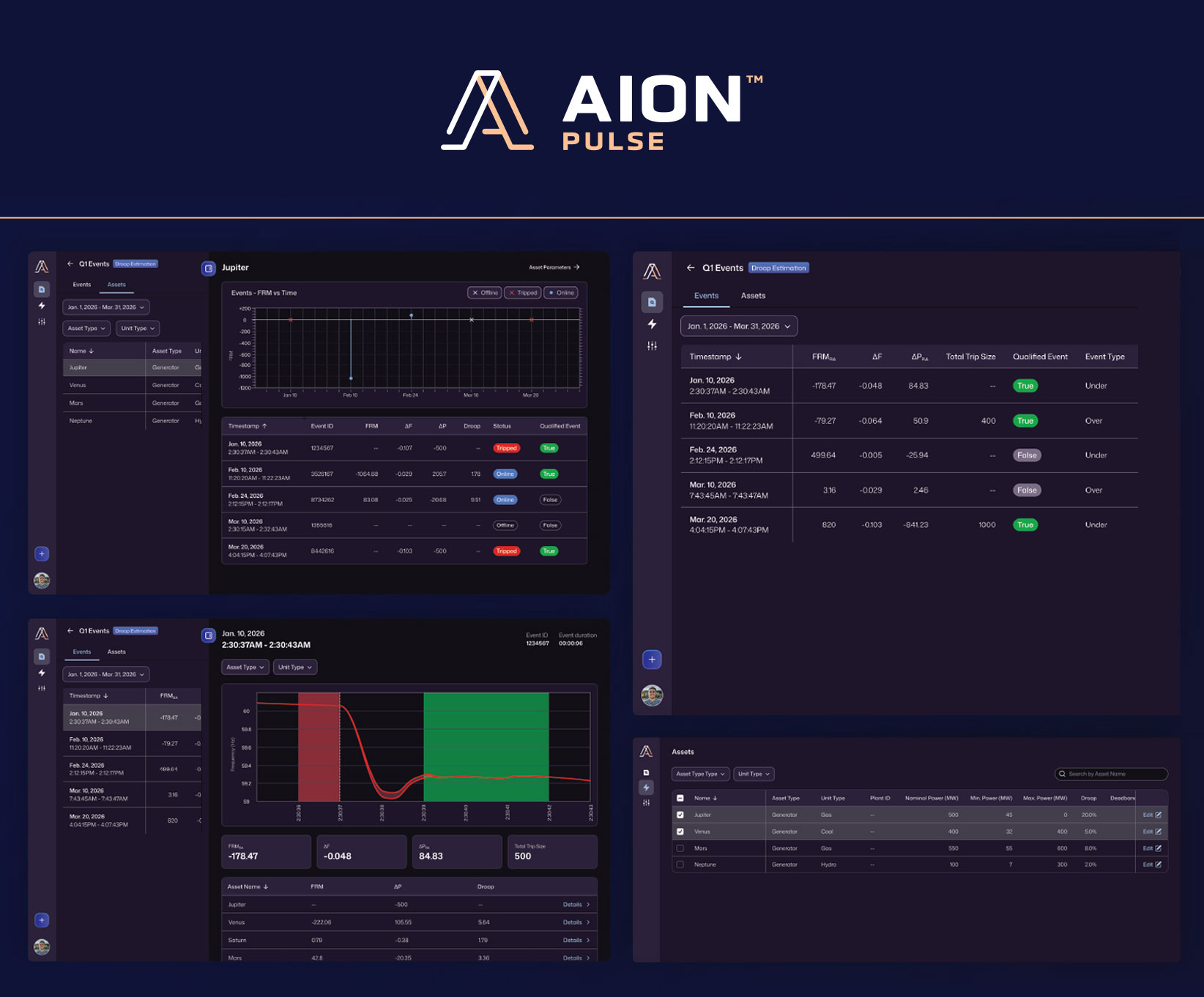
PNNL developed the Generator Scorecard to automate generator performance evaluation using measurement data from the grid. Simple Thread licensed the technology and is bringing it to market as Aion Pulse, building on the underlying research with the software engineering, product design, and power systems expertise needed for long-term utility use.
For Simple Thread, the project reflects a broader mission: bring better software to the energy industry.
Automating Generator Performance Monitoring
Generator performance monitoring is becoming increasingly important as the grid grows more dynamic. Utilities and balancing authorities need to understand how generating resources actually behave during frequency and voltage disturbances. That includes synchronous generators as well as a growing fleet of inverter-based resources whose control characteristics can differ significantly from traditional generation.
Historically, much of that evaluation has required engineers to identify events, gather measurement data, analyze individual resources, and compare measured responses against expected behavior.
The Generator Scorecard developed at PNNL demonstrated a more scalable approach.
Using PMU data, the technology can automatically detect disturbances and evaluate generator behavior using standardized performance metrics. The goal is not to replace detailed engineering analysis, but to help engineers quickly determine where that deeper investigation is needed.
Automation is most valuable when it allows engineering expertise to be applied where it has the greatest impact.
Moving From Research Software to Production Software
Research software is designed to answer an important question: Can this work?
Production software has to answer several more.
Can engineers use it reliably every day?
Can it work with the systems and data they already have?
Can users quickly understand what the analysis is telling them?
Can it be maintained, extended, deployed, and supported over time?
Those questions require a different set of disciplines alongside the underlying power systems research. Simple Thread brings together power systems engineers, software engineers, designers, and product expertise to help bridge that gap.
With Aion Pulse, that means preserving the rigor of the Generator Scorecard while developing the surrounding experience needed to make the technology practical for utility users.
The work extends beyond implementing algorithms. It includes thinking carefully about how engineers navigate large fleets of generators, how unusual behavior is surfaced, how results are explained, and how users move from a system-level signal to the specific plant or event that requires attention.
Good analytics are important. Making those analytics accessible and useful within an engineer’s workflow is what turns them into a product.
Amplifying Engineering Judgment
Aion Pulse is designed around a simple principle: software should amplify engineering judgment, not get in its way.
Instead of requiring engineers to manually review every generator after every disturbance, automated analysis can continuously evaluate performance across the fleet and identify where attention may be warranted. That changes the engineer’s role from searching for problems to investigating the ones that matter.
Aion Pulse can help utilities and balancing authorities:
- Automatically identify frequency and voltage disturbances.
- Evaluate generator response using consistent performance metrics.
- Assess frequency response and droop behavior.
- Measure reactive power response during voltage events.
- Track voltage schedule performance over time.
- Compare behavior across generators and events to identify patterns that warrant deeper investigation.
The value is not simply faster analysis. It is creating a repeatable process for turning large volumes of grid measurement data into information engineers can act on.
Bridging Power Systems and Software
Building effective utility software requires understanding both sides of the problem. The software has to be technically sound enough for engineers to trust the results. At the same time, the underlying power systems complexity cannot simply be exposed directly to every user. That balance is an important part of Simple Thread’s approach.
Our power systems engineers help ensure that the analysis reflects how generators and the grid actually behave. Our software and product teams focus on making that analysis reliable, scalable, understandable, and easier to use. That combination becomes especially important as utilities encounter increasingly complex operating conditions.
More inverter-based resources, larger and more dynamic loads, expanding measurement infrastructure, and evolving reliability requirements are all creating more data for engineers to evaluate. Simply giving teams more data is not enough.
The opportunity is to build software that helps them make sense of it.
Bringing the Generator Scorecard to Market
PNNL created and validated the Generator Scorecard technology. Simple Thread is now working with PNNL to carry that technology forward through Aion Pulse and make it available as commercially supported utility software. That transition creates an opportunity to continue learning directly from the utilities and balancing authorities who will use it.
Real-world deployment brings new questions about data availability, workflows, system integration, usability, and how different organizations evaluate generator performance. Those experiences can inform how the software continues to evolve. This is where Simple Thread sees a larger opportunity for the energy industry.
Important innovations do not always require inventing a completely new analytical method. Sometimes the breakthrough has already happened. The next challenge is making that breakthrough usable.
By combining rigorous power systems work with thoughtful software engineering and product design, research can move beyond a successful demonstration and become part of how engineers solve problems every day.
That is the role we want Simple Thread to play: helping bring better software to the grid.
Let’s Talk
If your organization is working through generator performance monitoring, PMU or SCADA data analysis, or the growing volume of disturbance data available to engineering teams, we’d like to hear how you are approaching it.
Loved the article? Hated it? Didn’t even read it?
We’d love to hear from you.